Articles & Videos
Sound Waves: Research insights into systematic synthetic phonics and word study to support literacy success
Categories

Subscribe to our newsletters
Receive teaching resources and tips, exclusive special offers, useful product information and more!
Back to Differentiation articles & videos
Sound Waves: Research insights into systematic synthetic phonics and word study to support literacy success
Sound Waves 12/5/26

Systematic synthetic phonics is an evidence-based method of teaching critical reading and spelling skills. It is considered to be the solid and essential foundation needed to carefully develop our students’ reading and spelling proficiency. Along with systematic synthetic phonics, students require explicit instruction covering morphology, orthography and etymology. So how does the trusted Sound Waves series fit into the picture?
Systematic synthetic phonics
Systematic synthetic phonics is a widely supported approach to phonics instruction that involves explicitly and systematically teaching the relationship between phonemes and graphemes. Instruction focuses on developing students’ ability to segment words into sounds and synthesise, or blend, sounds to form words.
Sound Waves lessons are systematically sequenced so students progress from learning simple, broadly applicable phoneme–grapheme relationships to studying those that are more complex and unusual. In the early years program, lessons also incorporate decodable texts to teach reading.
Orthography, morphology and etymology
According to Louisa Moats (2019) 1 and supported by Tessa Daffern’s Triple Word Form Theory 2 synthetic phonics is a critical component of learning to read and spell, but equally important is the knowledge of spelling patterns (orthography), meaningful parts of words (morphology) and the history and origin of words (etymology). Gaining a deep understanding of these areas supports vocabulary development, improves spelling accuracy and enhances reading comprehension. Therefore, as students transition from the early years through to middle and upper primary, instruction in these areas should amp up to align with the increase of vocabulary knowledge, writing capability and reading comprehension expected throughout with primary years.
Sound Waves achieves this in every unit through dedicated Focus Concept lessons targeting these areas of word study instruction. What’s more, alongside these Focus Concept lessons, the middle to upper primary Word Study program embeds key orthographic, morphological, etymological and vocabulary building concepts into the base systematic synthetic phonics lessons to deepen spelling and vocabulary skills.
The evidence
There has been a wealth of research in recent years analysing different approaches to teaching reading and spelling. This research shows that systematic synthetic phonics, together with orthography, morphology and etymology, are essential and effective methods for developing students’ reading and spelling proficiency.
Several relevant studies and reports from the past three decades are summarised below and have significantly informed the development of the Sound Waves series into what it is today!
2025 – The Australian Catholic University’s Centre for the Advancement of Literacy has completed a study finding that the inclusion of teaching of morphology not only leads to gains in reading and spelling but actually complements (not conflicts) with the teaching of phonics. Dr Danielle Colenbrander, who headed the research, stated that ‘Morphology instruction is therefore another useful tool to help students become fluent readers and writers’. 3
2025 – Timothy Shanahan’s article Blast from the Past: Is Morphology Training Better Than Phonics Instruction? represents a change of his previous viewpoint. He now acknowledges that current research not only supports the inclusion of morphology in reading and spelling instruction but recommends it as a means of supporting decoding and spelling. He now believes that the teaching of morphology alongside phonics is the preferred approach. 4
2024 – The Grattan Institute’s report on reading bases its recommendations on the fact that one third of Australian students are not effective, independent readers. It places the blame for this on what is known as the Reading Wars, stating that the multi-disciplinary research into reading firmly discredits the whole language approach in favour of a systematic, explicit approach to teaching reading. The report is in favour of governments and school leaders adopting a six-step reading guarantee, saying that Australia needs a ‘Reading Revolution’. The steps include:
- providing educators with clear guidelines and support for implementing evidence-based practices for teaching reading
- further supporting educators by providing curriculum and assessment material to enhance their ability to teach reading effectively. 5
2023 – Shannan Salvestro, NSW Department of Education’s Literacy Coordinator, has a conversation with Dr Tessa Daffern, senior lecturer at University of Wollongong, in which Daffern expresses her belief that spelling instruction should include instruction in phonology, orthography and morphology. Daffern explains that the goal of spelling is to communicate effectively and accurately in writing, and refers to research which finds that students finishing Kindergarten who are strong spellers will ultimately be strong readers and writers. She speaks of the effectiveness of explicit instruction in both phonological awareness and phonics, and that these should begin in Kindergarten along with an introduction to morphology and orthography. 6
2023 – The Queensland Reading Commitment states that every school in Queensland should approach reading instruction in the same way:
- following evidence-informed practices
- teaching synthetic phonics systematically and explicitly
- introducing beginning readers to decodable texts
- assessing students’ decoding skills. 7
2023 – Stocker, Fox, Swain and Leif claim that Australian classrooms are not all consistently using evidence-based practices when teaching reading and that this has resulted in the poor standard of reading proficiency currently identified in Australian students. They call for change to the way reading is taught, stating it needs to be based in both the science of reading and science of behaviour. They acknowledge that before effective reading instruction can be implemented in all classrooms across Australia, teacher training needs to be updated, support provided for educators in schools, and policies changed to reflect what is currently known about the science of reading. 8
2023 – The Australian Education Research Organisation (AERO) explains the cognitive science of how students learn to read and outlines the research into effective reading instruction. Emphasising the role of oral language development in the reading process, the paper provides a clear explanation of the Simple View of Reading and names five essential keys to reading, two of which are phonemic awareness and phonics. According to AERO, ‘Reading is a biologically secondary skill consisting of multiple cognitive functions, which must be taught systematically and through using evidence-based practices’ (p. 3). 9
2021 – Jocelyn Seamer explains why decodable texts are vital for reading success and points out that they are an essential part of a systematic approach to teaching reading. She carefully explains what they are, who should use them, and when and how to use them effectively. 10
2021 – In its Science of Reading: Defining Guide, The Reading League states that it views literacy as a fundamental human right and it is therefore committed to ensuring that educators are supported in their efforts to provide evidence-informed reading instruction. This guide provides a clear definition of the science of reading, along with a detailed explanation of how the Simple View of Reading and Scarborough’s Reading Rope help to explain how reading works in the brain. It goes on to list a range of instructional practices that align with the science of reading. It concludes with a plea to all stakeholders – everyone involved in education – to inform themselves about the science of reading and use that knowledge to implement effective research-informed teaching practices. ‘We call on educators to embrace opportunities to learn about the science of reading, reflect upon their practice, and challenge approaches to reading instruction that are not aligned with the scientific evidence’ (p. 28). 11
2020 – Louisa Moats embraces the Simple View of Reading and Scarborough’s Reading Rope as theoretical models that help to explain how reading takes place in the brain. Her clear message is that the most critical job of schools and teachers is to teach students to read, but in order to do that effectively, teachers must be familiar with the science of reading and ensure that it informs their teaching practices. She points out that as yet, what is known from the research isn’t evident in teaching preparation courses nor available as professional development for the majority of teachers. She is adamant that it is possible to teach most students to read and that this skill will have a lasting impact on their academic progress as well as their social, emotional and physical wellbeing. In Moats’s words, ‘Teaching reading is rocket science. But it is also established science, with clear, specific, practical instructional strategies that all teachers should be taught and supported in using’ (p. 9). 12
2020 – Levesque, Breadmore and Deacon’s article How Morphology Impacts Reading and Spelling: Advancing the Role of Morphology in Models of Literacy Development addresses concerns that although there is strong evidence supporting the inclusion of morphology instruction into the teaching of reading and spelling, that it is not well-represented in existing models of reading such as the Simple View of Reading. The article outlines the strong links between teaching morphology and improvement in literacy skills including decoding, spelling and reading comprehension and proposes a framework they call The Morphological Pathways Framework. 13
2020 – Linnea Ehri outlines the findings of various studies she has carried out with colleagues into how reading words takes place in the brain. She notes that effective readers need grapheme–phoneme knowledge, and segmenting and decoding skills. She concludes that beginning readers should receive systematic phonics instruction. 14
2018 – Castles, Rastle and Nation refer to years of debate about how reading should be taught and the disconnect between what is known about the science of reading and how reading is taught in classrooms. According to them, ‘… phonics instruction is so central to learning in a writing system such as English’ (p. 5). Their review includes research on what children need to become expert readers and how that can be incorporated into effective teaching. They call for an end to the Reading Wars, maintaining that what is needed is a thorough understanding of the scientific research into how language develops. 15
2017 – Daniel Willingham takes a cognitive approach to explaining what is happening in the brain when we are reading. He draws a close connection between reading and writing, and makes it clear that explicit teaching of a written code is essential to learning to read. 16
2017 – Mark Seidenberg uses cognitive neuroscience to explain how the brain learns to read and process language, and how those findings can and should be applied in the classroom. He says that the 3 cueing system does not align with how reading actually occurs in the brain and that teachers need to understand the science of reading in order to teach reading effectively. 17
2014 – Linnea Ehri describes how children build their sight word vocabulary through a cognitive process known as orthographic mapping. For orthographic mapping to occur, students must be explicitly taught phonemic awareness and grapheme–phoneme relationships. 18
2012 – Johnston, McGeown and Watson assess 10-year-olds who participated in the Clackmannanshire study in their early years of schooling, comparing the abilities of those taught using synthetic phonics with those taught using an alternative method of phonics. The study finds, ‘Overall, the group taught by synthetic phonics had better word reading, spelling, and reading comprehension’ (p. 1365). 19
2007 – Macquarie University Professor Max Coltheart and University of Melbourne Professor Margot Prior analyse global studies and Australian literature. They confirm that ‘systematic instruction in phonics is an essential component of any effective method of teaching reading’ (p. 5). 20
2006 – The Independent Review of the Teaching of Early Reading (commonly called The Rose Report) provides unambiguous recommendations for teaching reading and spelling, stating, ‘Having considered a wide range of evidence, the review has concluded that the case of systematic phonic work is overwhelming and much strengthened by a synthetic approach …’ (p. 20). 21
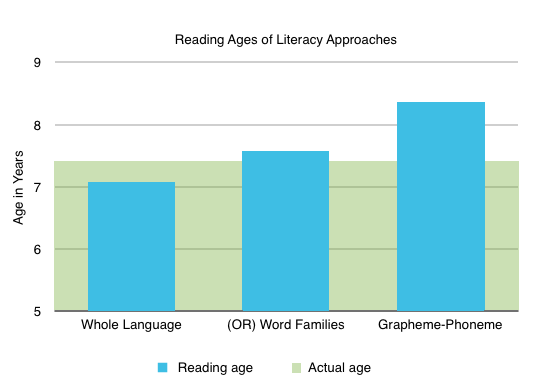
2005 – Christensen and Bowey compare the progress of children taught using synthetic phonics with those taught using alternative methods of phonics instruction. Children who were taught using synthetic phonics outperformed children in comparison groups on measures of spelling, word reading and reading comprehension. Their study shows distinct benefits of the grapheme–phoneme approach (see Fig 1), with significantly higher reading ages and clearly improved skills, including:
- ‘better at spelling transfer words’
- ‘faster at reading program words’
- ‘significantly better in reading comprehension’
- ‘greater competence in … the accuracy and speed of decoding unfamiliar [transfer] words’ (p. 344). 22
Fig 1
2005 – Johnston and Watson release the findings of a seven-year longitudinal Clackmannanshire study comparing children taught using synthetic phonics with children taught using alternative methods of phonics. They find, ‘At the end of the programme, the synthetic phonics taught group were reading and spelling 7 months ahead of chronological age. They read words around 7 months ahead of the other two groups, and were 8 to 9 months ahead in spelling’ (p. 8). 23
2005 – The Australian Government’s National Inquiry into the Teaching of Literacy report recommends that ‘teachers provide systematic, direct and explicit phonics instruction so that children master the essential alphabetic code-breaking skills required for foundational reading proficiency’ (p. 14). 24
2000 – The National Reading Panel in the US conducts a review of research, finding that systematic synthetic phonics significantly helps children struggling to read and also benefits good readers. The study concludes, ‘Systematic phonics instruction has been used widely over a long period of time with positive results’ (p. 96). 25
And many more studies dating back to the 1960s, including Jeanne Chall’s Learning to Read: The Great Debate which argued that code-emphasis instruction (phonics) produced stronger literacy skills than meaning-emphasis instruction (whole language). 26 These findings still stand alongside recent and ongoing research.
The Sound Waves series: A smart choice for Australian educators
The Sound Waves series has been a trusted favourite in Australian primary schools for decades, and has continually evolved to meet the pedagogical and practical requirements of the modern classroom.
With a wealth of improvements in the recent years, the series is now split into two distinct, but complementary, programs to suit the specialised nature of instruction required as students transition across the primary years:
The Sound Waves Early Literacy program for Foundation to Year 2 provides essential reading and spelling instruction using a systematic synthetic phonics approach and Decodable Readers.
The new edition Sound Waves Word Study program for Years 3 to 6 continues to use systematic synthetic phonics as its base, but deepens and extends instruction in spelling patterns and grapheme choice (orthography), word parts (morphology) and word origins (etymology). The result: a powerful approach to developing in-depth spelling skills that students need for ongoing literacy success.
Both programs provide teachers with everything they need to deliver effective and practical literacy instruction that:
- uses an evidence-based approach
- follows a systematic sequence of instruction
- meets national and state curricula requirements
- provides detailed and practical lesson resources to facilitate explicit instruction
- includes engaging consolidation Student Book activities to reinforce concepts learned in lessons
- incorporates frequent and targeted assessment with remediation resources
- offers ongoing and tailored professional learning and support for schools – and at no extra cost!
Take the next step: book free professional learning for your school with one of our experienced Education Consultants or sign up for a free trial to explore our explicit teaching resources firsthand.
References
Moats, LC 2019, ‘Phonics and Spelling: Learning the Structure of Language at the Word Level’, in: D Kilpatrick, R Joshi & R Wagner (eds), Reading Development and Difficulties, Springer, Cham, https://doi.org/10.1007/978-3-030-26550-2_3.↩
Daffern, T, Hogg, K, Callaway, N, Wild, H & Kelly, S 2024 Supporting schools to implement an evidence-based and effective approach to teaching spelling, Bulletin of Learning Difficulties Australia, viewed 12 May 2026, https://www.tessadaffern.com/wp-content/uploads/2024/10/Daffern-et-al-2024-Supporting-schools-to-implement-an-evidencebased-and-effective-approach-to-teaching-spelling.pdf.↩
Colenbrander, D 2025 Morphology improves spelling and reading - new research, Australian Centre for the Advancement of Literacy, viewed 12 May 2026, https://www.acu.edu.au/about-acu/news/2025/january/morphology-improves-spelling-and-reading-new-research#:~:text=%E2%80%9CWhen%20students%20start%20to%20come,%2C%20spelling %20and%20vocabulary%20instruction.%E2%80%9D↩
Shanahan, T 2025, Blast from the Past: Is Morphology Training Better Than Phonics Instruction?, Shanahan on Literacy, viewed 12 May 2026, https://www.shanahanonliteracy.com/blog/blast-from-the-past-is-morphology-training-better-than-phonics-instruction#:~:text=The%20reason%20why%20I%20insist,as%20new%20evidence%20has%20accumulated.↩
Hunter, J, Stobart, A & Haywood, A 2023, The Reading Guarantee: How to give every child the best chance of success, Grattan Institute, viewed 12 May 2026, https://grattan.edu.au/wp-content/uploads/2024/02/The-Reading-Guarantee-Grattan-Institute-Report.pdf.↩
NSW Department of Education 2023, In conversation with Dr Tessa Daffern - teaching spelling (podcast), viewed 12 May 2026, https://education.nsw.gov.au/teaching-and-learning/curriculum/literacy-and-numeracy/professional-learning/podcasts/transcript-tess-daffern.↩
Queensland Department of Education 2023, Queensland’s Reading Commitment, viewed 12 May 2026, https://education.qld.gov.au/curriculum/stages-of-schooling/queenslands-reading-commitment.↩
Stocker, KL, Fox, RA, Swain, NR & Leif, ES 2023, ‘Between the lines: Integrating the science of reading and the science of behavior to improve reading outcomes for Australian children’, Behavior and Social Issues, viewed 12 May 2026, https://doi.org/10.1007/s42822-023-00149-y.↩
Australian Education Research Organisation (AERO) 2023, Introduction to the science of reading, viewed 12 May 2026, https://www.edresearch.edu.au/sites/default/files/2023-01/AERO-Introduction-to-the-science-of-reading.pdf.↩
Seamer, J 2021, ‘The role of decodable texts in learning to read’, Learning Difficulties Australia Bulletin, vol. 53, no. 2, pp. 23-24, viewed 12 May 2026, https://ldaustralia.org/wp-content/uploads/2021/09/1155-LDA-Bulletin-August-2021_WEB.pdf.↩
The Reading League 2021, Science of Reading: Defining Guide, viewed 12 May 2026, https://www.thereadingleague.org/wp-content/uploads/2022/03/Science-of-Reading-eBook-2022.pdf.↩
Moats, LC 2020, ‘Teaching reading is rocket science: What expert teachers of reading should know and be able to do’, American Federation of Teachers, viewed 12 May 2026, https://www.aft.org/sites/default/files/moats.pdf.↩
Levesque, KC, Breadmore, H, Deacon, SH 2021 ‘How morphology impacts reading and spelling: Advancing the role of morphology in models of literacy development’, Journal of Research in Reading, vol. 44, no. 1, pp. 10-26. https://pure.coventry.ac.uk/ws/files/54587245/Binder0025.pdf.↩
Ehri, LC 2020, ‘The science of learning to read words: A case for systematic phonics instruction’, Reading Research Quarterly, International Literacy Association, vol. 55(S1), pp. S45-S60, viewed 12 May 2026, https://www.goodteaching.ca/uploads/6/0/4/9/60496921/science_of_reading_words.pdf.↩
Castles, A, Rastle, K & Nation, K 2018, ‘Ending the Reading Wars: Reading acquisition from novice to expert’, Psychological Science in the Public Interest, vol. 19, no. 1, pp. 5-51, viewed 12 May 2026, https://journals.sagepub.com/doi/10.1177/1529100618772271.↩
Willingham, DT 2017, The reading mind: A cognitive approach to understanding how the mind reads, Jossey-Bass, Indianapolis.↩
Seidenberg, M 2017, Language at the speed of sight: How we read, why so many can’t, and what can be done about it, Basic Books, New York.↩
Ehri, LC 2014, ‘Orthographic mapping in the acquisition of sight word reading, spelling memory, and vocabulary learning’, Scientific Studies of Reading, vol. 18, no. 1, pp. 5-21, viewed 12 May 2026, https://www.tandfonline.com/doi/abs/10.1080/10888438.2013.819356.↩
Johnston, RS, McGeown, S & Watson, JE 2012, ‘Long-term effects of synthetic versus analytic phonics teaching on the reading and spelling ability of 10 year old boys and girls,’ Reading and Writing, vol. 25, no. 6, pp.1365-1384, viewed 12 May 2026, https://www.research.ed.ac.uk/en/publications/long-term-effects-of-synthetic-versus-analytic-phonics-teaching-o.↩
Coltheart, M & Prior, M 2007, Learning to read in Australia, The Academy of Social Sciences in Australia, viewed 12 May 2026, https://www.fireflyeducation.com.au/downloads/Learning_to_Read_In_Australia_Coltheart_Prior.pdf. ↩
Rose, J 2006, Independent review of the teaching of early reading, UK Department for Education and Skills, viewed 12 May 2026, https://dera.ioe.ac.uk/5551/2/report.pdf.↩
Christensen, CA & Bowey, JA 2005, ‘The efficacy of orthographic rime, grapheme–phoneme correspondence, and implicit phonics approaches to teaching decoding skills’, Scientific Studies of Reading, vol. 9, no. 4, pp. 327–349, https://www.researchgate.net/publication/43472817_The_Efficacy_of_Orthographic_Rime_Grapheme-Phoneme_Correspondence_and_Implicit_Phonics_Approaches_to_Teaching_Decoding_Skills.↩
Johnston, R & Watson, J 2005, The effects of synthetic phonics teaching on reading and spelling attainment: A seven year longitudinal study, Scottish Executive Education Department, viewed 12 May 2026, https://dera.ioe.ac.uk/14793/1/0023582.pdf.↩
Rowe, KJ 2005, Teaching reading: Report and recommendations, Department of Education, Science and Training: National Inquiry into the Teaching of Literacy, viewed 12 May 2026, https://research.acer.edu.au/cgi/viewcontent.cgi?article=1004&context=tll_misc.↩
National Reading Panel (US) 2000, Report of the National Reading Panel: Teaching children to read: An evidence-based assessment of the scientific research literature on reading and its implications for reading instruction, National Institute of Child Health and Human Development, viewed 12 May 2026, https://www.nichd.nih.gov/sites/default/files/publications/pubs/nrp/Documents/report.pdf.↩
Chall, JS 1967, Learning to Read: The Great Debate, New York: McGraw-Hill.↩