Articles & Videos
Continuing explicit spelling instruction through middle and upper primary improves literacy outcomes
Categories

Subscribe to our newsletters
Receive teaching resources and tips, exclusive special offers, useful product information and more!
Back to Product Features articles & videos
Continuing explicit spelling instruction through middle and upper primary improves literacy outcomes
Sound Waves 20/8/26
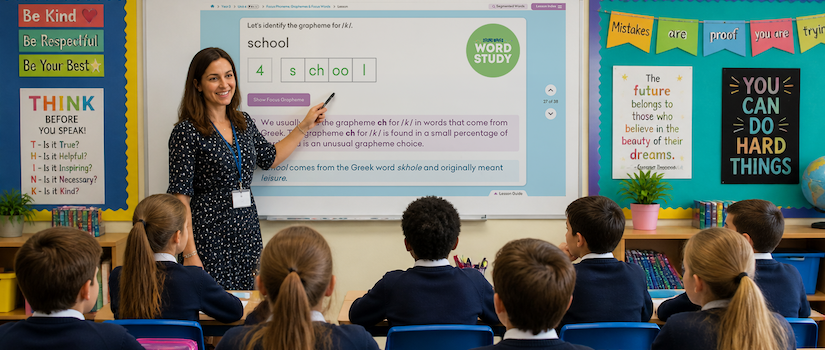
As schools review literacy practice ahead of the 2027 school year, renewed attention is turning to how spelling should be taught beyond the early years. Explicit spelling instruction is now standard practice in early primary classrooms. But what should happen as students move into middle and upper primary?
Why is systematic synthetic phonics instruction valuable beyond the early years?
Research confirms that explicit spelling instruction, including systematic synthetic phonics, should continue from Foundation right through to Year 6, extending well past the early decoding stage.
Systematic synthetic phonics is widely recognised as the most effective approach to teaching reading and spelling, a view supported by current science of reading evidence and reflected across Australian English curriculum and syllabus documents. It involves the explicit, systematic teaching of phoneme–grapheme (sound–letter) relationships, taught in a sequence that moves from simple to increasingly complex. As Dr Ken Rowe argues in his landmark 2005 national inquiry report, understanding the alphabetic code in this way is essential for fluent and meaningful reading and writing.
A growing body of research supports continuing systematic synthetic phonics beyond the early years. Developmental psychologist Rebecca Treiman (2018) argues that explicit, structured spelling instruction remains important throughout schooling. Treiman recommends increasing a focus on spelling patterns and pairing this instruction with the teaching of morphology (word parts) as students’ vocabulary expands. Put simply, children spell more efficiently when they systematically study words.
Most students decode efficiently by the end of the early years, but decoding continues to play an important role in middle to upper primary when students come across new and more complex vocabulary. This is particularly the case as they are introduced to technical vocabulary relating to other learning areas such as mathematics, geography and science. When decoding becomes automatic, students can devote more of their cognitive resources to understanding what they are reading. For this reason, continuing explicit instruction in phoneme–grapheme relationships and the more complex features of the alphabetic code remain an essential component of literacy instruction beyond the early years.
Unsurprisingly, the key with systematic synthetic phonics in middle to upper primary is for it to be part of a more advanced and integrated approach to literacy instruction. According to La Trobe University’s Tessa Daffern, and the triple word form theory (Richards et al., 2006), spelling is not a simple sequence where one skill is mastered before the next begins. In her 2017 Australian spelling study, Daffern argues that reading and writing effectively require understanding the phonology (speech sounds), orthography (spelling patterns), and morphology (word parts) of our language. These three components can and should be taught together rather than in isolated stages.
This matters particularly for middle and upper primary students, who have already built a foundation in basic phoneme–grapheme relationships. They should be taught more complex and unusual phoneme–grapheme relationships while going deeper into the structure and history of the language. Rather than rote learning word lists for weekly tests, students should segment words, learn spelling patterns, and also recognise word meaning through suffixes, prefixes and shared roots.
How does spelling instruction play a part in reading and writing development in Years 3 to 6?
Spelling instruction is more than just spelling. It is inextricably linked to reading and writing development.
In the early years, reading instruction should involve decodable texts, giving students the chance to directly practise and consolidate the phoneme–grapheme relationships they learn in spelling lessons. Through repeated reading of these texts, students develop accurate word recognition through orthographic mapping, a process that stores words permanently in long-term memory for automatic retrieval. As a result, students move beyond letter-by-letter decoding towards recognising words effortlessly and fluently, which in turn supports improved reading comprehension.
As students move into middle and upper primary, effective spelling instruction moves beyond basic phoneme-grapheme relationships to increasingly incorporate morphology, orthography and etymology (word origins). This helps students recognise the meaningful parts of words, predictable spelling patterns, and the history behind them. These interconnected understandings support automaticity with reading and writing words, particularly as the vocabulary they work with expands and increases in complexity, allowing students to have greater cognitive space for higher level processes such as comprehending and discussing texts. The same applies to writing – students can focus on organising and expressing ideas, rather than the mechanics of spelling. Graham and Hebert (2017) point to research showing spelling instruction benefits word reading across the primary school years.
Spelling isn’t just about getting words right – it plays a central role behind every fluent reader and confident writer, leaving a lasting impact on students’ literacy as they progress into adulthood.
What is morphology and why is it important in the teaching of spelling?
Morphology digs deeper into word study and refers to the meaningful parts of words – the prefixes, suffixes and roots that carry their own meaning. Take the prefix bi, meaning ‘two’. Once students know the meaning, bicycle and bilingual start to make sense. The suffix ful means ‘full of’, so joyful and hopeful suddenly click. And the root audi, meaning ‘to hear’, unlocks both auditorium and audience.
Incorporating morphology into spelling instruction is key to substantially expanding students’ vocabulary. Recent research from Danielle Colenbrander (2024) reinforces this, noting that morphology instruction can improve spelling of words students haven’t been directly taught, as they draw on morphological knowledge to work out unfamiliar words. Morphology instruction doesn’t just build understanding of prefixes, suffixes and roots – it gives students a tool for continually growing their own vocabulary.
Understanding word parts, alongside decoding, frees up mental space for reading and writing. Recent researchers, including Australian Catholic University (2025), strongly support the explicit teaching of morphology as part of a well-structured spelling program. Morphological instruction also has a direct impact on writing development. McCutchen et al. (2014) report that a morphology intervention improved students’ writing, showing consistent gains in word choice, spelling accuracy, sentence construction and use of technical language.
How does the Sound Waves Word Study program align with current research?
All this research raises a practical question for schools: how can this evidence be translated into everyday classroom practice?
The new edition Sound Waves Word Study program for Years 3 to 6 combines all this research and translates it into a practical and engaging suite of resources – giving teachers the tools to deliver effective, evidence-based spelling instruction with ease and confidence.
For any school already using a structured early literacy program in the early years, the Sound Waves Word Study program is the perfect follow-on as it continues to use systematic synthetic phonics as its base, while deepening and extending instruction in spelling patterns and grapheme choice (orthography), word parts (morphology) and word origins (etymology). The result: a powerful approach to developing in-depth spelling skills and broadening vocabulary, something that students need for ongoing literacy success.
To explore the resources firsthand, sign up for a free trial. If your school is ready to take the next step and implement effective spelling and word study instruction in Years 3 to 6, reach out to your local Firefly Education Consultant for a meeting or to secure a complimentary professional learning workshop.
Bibliography
Australian Curriculum, Assessment and Reporting Authority 2026, English Curriculum F-6, viewed 17 August 2026, https://www.australiancurriculum.edu.au/
Colenbrander, D 2025, Morphology improves spelling and reading - new research, Australian Centre for the Advancement of Literacy, viewed 17 August 2026, https://www.acu.edu.au/about-acu/news/2025/january/morphology-improves-spelling-and-reading-new-research
Colenbrander, D, von Hagen, A, Kohnen, S, Wegener, S, Ko, K, Beyersmann, E, Behzadnia, A, Parrila, R & Castles A 2024, ‘The effects of morphological instruction on literacy outcomes for children in English-speaking countries: A systematic review and meta-analysis’, Educational Psychology Review, volume 26, no. 119, https://link.springer.com/article/10.1007/s10648-024-09953-3#Sec12
Daffern, T 2017, ‘Linguistic skills involved in learning to spell: An Australian study’, Language and Education, vol. 31, no. 4, pp. 307-329, https://doi.org/10.1080/09500782.2017.1296855
Graham, S & Hebert, M 2011, ‘Writing to read: A met-analysis of the impact of writing and writing instruction on reading’, Harvard Educational Review, vol. 81, no. 4, pp. 710-744, https://www.harvardeducationalreview.org/content/81/4/710
Hempenstall, K 2018, Feel like a spell? Effective spelling instruction: Implications for practice of current research on spelling, https://www.nifdi.org/resources/hempenstall-blog/390-feel-like-a-spell.html
McCutchen D, Stull S, Herrera BL, Lotas S, Evans S 2014, ‘Putting words to work: Effects of morphological instruction on children’s writing’, Journal of Learning Disabilities, vol. 47, no. 1, pp. 86-97, https://pmc.ncbi.nlm.nih.gov/articles/PMC3862351/
NSW Department of Education 2026, Phonic knowledge: Key Information to support teachers in understanding and implementing the focus area of phonic knowledge in their classroom, viewed 17 August 2026, https://education.nsw.gov.au/teaching-and-learning/curriculum/english/planning-programming-and-assessing-english-k-6/phonic-knowledge
Ouelette, G & Sénéchal, M 2017, ‘Invented spelling in kindergarten as a predictor of reading and spelling in Grade 1: A new pathway to literacy, or just the same road, less known? Developmental Psychology, vol. 53, no. 1, pp. 77-88, http://dx.doi.org/10.1037/dev0000179
Queensland Department of Education 2023, Reading Position Statement, viewed 17 August 2026, https://education.qld.gov.au/curriculums/Documents/reading-position-statement.pdf#search=spelling
Richards TL, Aylward EH, Field KM, Grimme AC, Raskind W, Richards AL, Nagy W, Eckert M, Leonard C, Abbott RD, Berninger VW 2010, ‘Converging evidence for triple word form theory in children with dyslexia’, Developmental Neuropsychology, vol. 30, no. 1, pp. 547-589, https://doi.org/10.1207/s15326942dn3001_3
Rowe, KJ 2005, Teaching reading: Report and recommendations, Department of Education, Science and Training: National Inquiry into the Teaching of Literacy, https://research.acer.edu.au/cgi/viewcontent.cgi?article=1004&context=tll_misc
Tremain, R 2018, ‘Statistical learning and spelling’, Language, Speech, and Hearing Services in Schools, vol. 49, no. 35, pp. 644-652, https://doi.org/10.1044/2018_LSHSS-STLT1-17-012
Victorian Department of Education 2026, Phonics: A Guide for parents and carers, viewed 17 August 2026, https://www.vic.gov.au/phonics-guide-parents-and-carers
Victorian Curriculum and Assessment Authority 2026, Curriculum F-10, https://f10.vcaa.vic.edu.au/download-curriculum