Articles & Videos
What are Sound Waves Focus Words and what makes them meaningful?
Categories

Subscribe to our newsletters
Receive teaching resources and tips, exclusive special offers, useful product information and more!
Back to Research & Case Studies articles & videos
What are Sound Waves Focus Words and what makes them meaningful?
Sound Waves 13/8/26

When it comes to spelling, selecting words that are worth focusing on is crucial to success. Every unit in Sound Waves includes a curated set of Focus Words. There’s more than meets the eye with these seemingly humble words, so let’s unpack what Focus Words are, why they were chosen, how they are used in lessons and more!
What are Focus Words?
Focus Words are a carefully selected set of words that contain the focus phoneme studied in a given unit and they are used to underpin your explicit teaching of spelling and word study. You’ll use these words to introduce, demonstrate and foster knowledge about phoneme–grapheme relationships. These words include a variety of graphemes in a range of positions.
Focus Words contain a mix of Tier 1, 2 and 3 vocabulary so students are exposed to a range of words. Tier 1 words are high-frequency words students encounter in everyday life, such as jump, said, because and through. Tier 2 words are less commonly encountered words but they are useful across many subject domains, such as cycle, government, organise and research. Tier 3 words are considered technical vocabulary, such as amphibian, lava and bacteria. The range of Focus Words not only demonstrates different phoneme–grapheme relationships but also supports students’ vocabulary development.
What are some misconceptions about lists of words?
Lists of spelling words can sometimes have a bad reputation. Usually this stems from the use of traditional spelling lists of unrelated words that students are encouraged to memorise. Memorisation of words doesn’t support long-term recall, doesn’t assist students in understanding how words work and doesn’t provide students with the ability to transfer knowledge of spelling into writing.1 2
It’s important to understand that Focus Words are not designed to be a list of words students memorise. It’s equally important to understand that Focus Words will only make up a small percentage of the words students will need to be able to spell by the time they reach adulthood. The aim is to use Focus Words as a tool for students to gain an understanding of phoneme–grapheme relationships and patterns they can then apply to a greater number of words.
How were the Focus Words curated?
Each set of Focus Words is displayed in a logical order. Typically, single-syllable words precede multisyllabic words, and common phoneme–grapheme relationships precede complex or unusual phoneme–grapheme relationships.
Year 2 Example
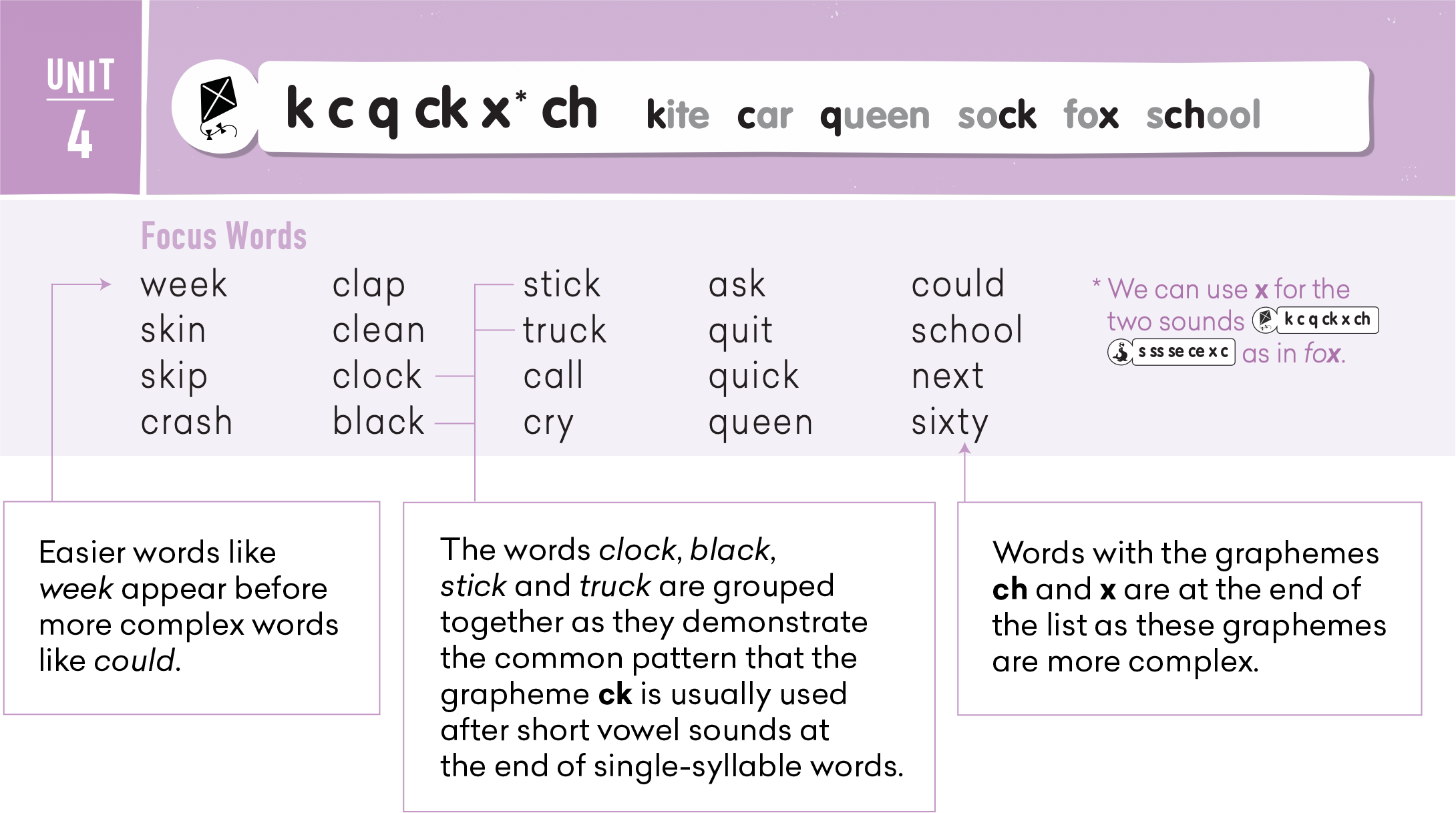
In Years 5–6, the Focus Words are grouped a little differently to align with the explicit teaching sequence. Words that relate to the Focus Concepts are generally grouped at the end of the set.
Year 6 Example
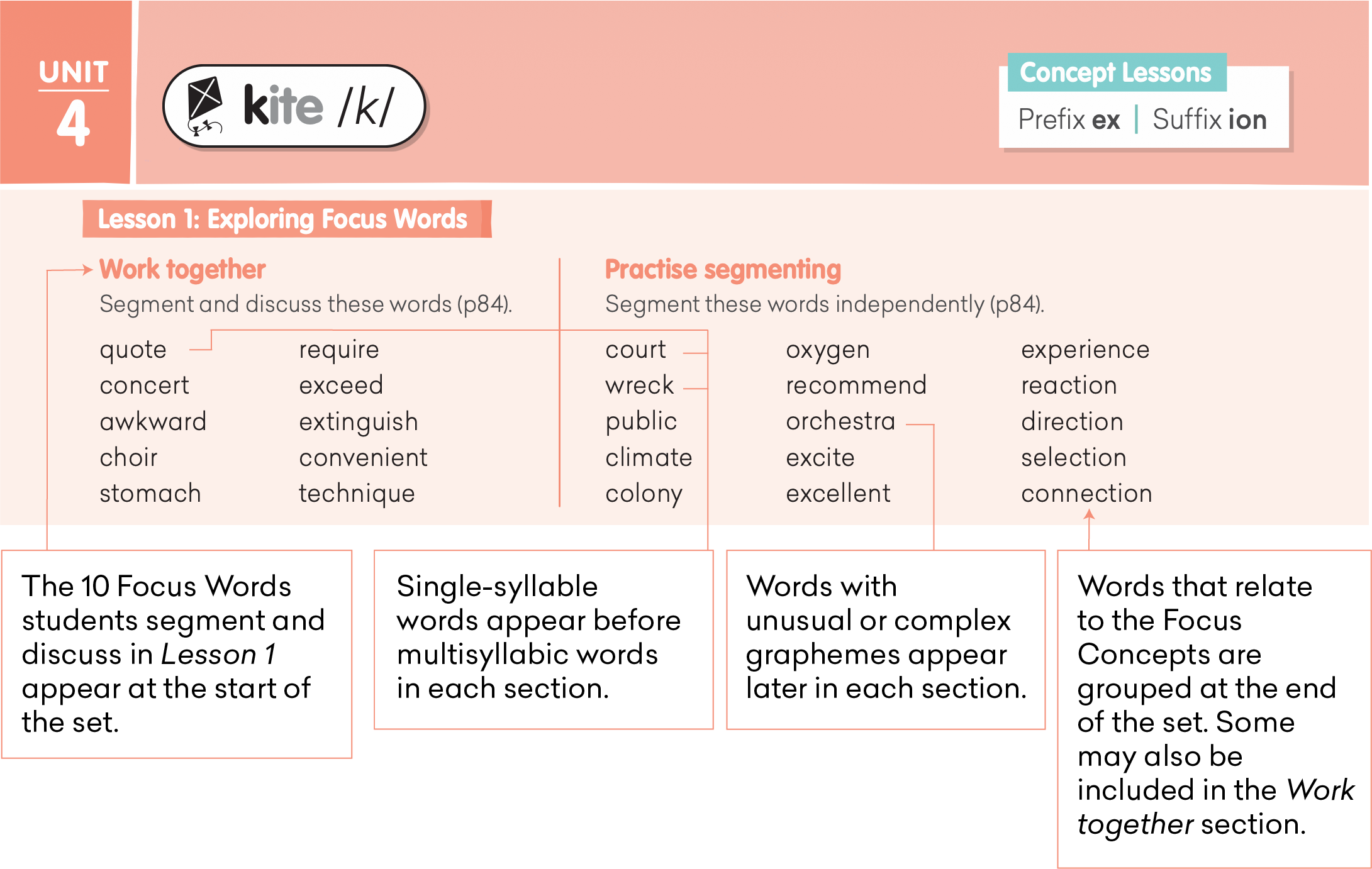
How are Focus Words beneficial to learning?
Sets of curated words like Focus Words help students understand the English spelling system. Each set of Focus Words illustrates a range of different phoneme–grapheme relationships and also demonstrates morphology principles. This allows students to learn how words work.
Using the Focus Words, students can:
Identify the graphemes used to represent the focus phoneme.
For example, /ng/ can be represented by ng as in sing, n as in blink or ngue as in tongue.
Investigate the common position of the focus phoneme in words.
For example, /ng/ never starts a word. It is commonly found at the end of words, like in ring, bang and strong.
Learn how the sounds that come before or after the focus phoneme can influence grapheme choice.
For example, /ng/ is often represented by the grapheme n if it comes before /k/ or /g/, like in donkey, anchor, finger and language.
Understand morphemes within a word.
For example, in the word extract the prefix ex means out and the Latin root tract means pull. Extract literally means to pull out.
Comprehend irregular phoneme–grapheme relationships.
For example, the word said is spelled with the digraph ai for /e/.
When will you use them in lessons?
In Lesson 1 of every unit, students interact with and investigate the Focus Words in depth. Students in different year levels engage with Focus Words in different ways.
Read and Sort the Focus Words
In Years 2–4, use the Read, Sort, Discuss tool as part of Lesson 1 to model correct pronunciation and identify the grapheme representing the focus phoneme. This crucial step gives students the opportunity to read, discuss and investigate the graphemes in each word.
Play Find a Word and Identify the Focus Word
Playing Find a Word in Years 1–2 provides an opportunity for students to explore unusual elements within the Focus Words and discuss their meanings. Find a Word clues also ask students to demonstrate phonemic awareness and vocabulary knowledge. Students are prompted to consider phonemes, graphemes, definitions and Focus Concepts such as contractions. For example, a Find a Word clue that asks students to find words with q for /k/ could lead to a discussion about how the grapheme q for /k/ is followed by u for /w/ in each relevant Focus Word.
In Years 3–4, the Find a Word clues focus on vocabulary concepts such as synonyms and antonyms, as well as prompting students to draw on their knowledge of word definitions. In addition, information about the morphology, etymology or definition of the Focus Word is shown with each answer to further support students’ vocabulary building.
In Years 5–6, the Identify the Focus Word section of Lesson 1 also focuses heavily on the definitions, synonyms, antonyms and usage of the Focus Words. The clues prompt students to draw on their knowledge of Focus Concepts and help them further build their vocabulary.
Segmenting practice
Segmenting words strengthens the connection between the phoneme and the grapheme representing it. This fosters the ability to recognise words automatically (a process called orthographic mapping). In Years 1–4 you will explicitly model segmenting some of the Focus Words (either by hand on a whiteboard or using the Segmenting Tool) before students practise segmenting independently. In Years 5–6, you will undertake guided segmenting practice with students using some of the Focus Words, then they will practise segmenting independently using the remaining Focus Words.
In Years 1–2 students have opportunities to segment words within the Student Book activities. In Years 3–6 students segment all the Focus Words using the dedicated segmenting sheets at the back of their Students Books or the printable sheets available at Sound Waves Online.
Word study
In Years 3–4, the Focus Words underpin the explicit teaching of phoneme–grapheme relationships and word study skills in Lesson 1. Students revise and learn graphemes, unpack spelling patterns and conduct guided segmenting practice.
As part of Lesson 1 in Years 5–6, students segment 10 of the unit’s Focus Words and they are explicitly taught the morphology, etymology and meaning of the words. This in-depth approach to studying the Focus Words helps to build students’ spelling and vocabulary skills.
Students also have opportunities to work with the Focus Words throughout the week, whether that be in the Student Book activities, during Focus Concept lessons, or using the resources in the Games & Extra Activities section of the unit.
So there you have it – the Sound Waves Focus Words are much more than a simple list. They are research-informed, rigorous and have been carefully selected to help students achieve spelling success.
References
- Hempenstall, K 2018, Feel like a spell? Effective spelling instruction, National Institute for Direct Instruction, https://www.nifdi.org/news-latest-2/blog-hempenstall/390-feel-like-a-spell/↩
- Westwood, P 2014, ‘Spelling: do the eyes have it?’, Australian Journal of Learning Difficulties, 20(1), 3–13, https://doi.org/10.1080/19404158.2014.921632. ↩