Articles & Videos
Modelled reading strategies for your early literacy lessons
Categories

Subscribe to our newsletters
Receive teaching resources and tips, exclusive special offers, useful product information and more!
Back to Research & Case Studies articles & videos
Modelled reading strategies for your early literacy lessons
Sound Waves 5/5/26
Modelled reading is an essential practice in early literacy classrooms, offering your students a window into what fluent, confident reading looks and sounds like. When you read aloud with purpose, you do far more than tell a story – you demonstrate the strategies, behaviours and thinking processes that underpin successful reading.
For students who are developing foundational reading skills through the use of decodable readers, this kind of modelling provides crucial scaffolding. It helps them hear fluent reading, see how meaning is constructed and learn how to approach unfamiliar words or ideas.
Let’s use the Year 1 Decodable Reader Wobble Wobble Wombat to illustrate some of the strategies you can incorporate into your modelled reading lessons to help build a class of confident, capable readers.
Fluency modelling
Reading with expression, varied intonation and clear phrasing models what fluent reading sounds like. Beginning readers often default to reading quite mechanically – word by word or in choppy segments – so hearing a text read smoothly and expressively helps them understand how sentences naturally flow. It also supports comprehension, as students are more likely to understand a text when they hear it read with meaning and appropriate pace.
In some cases you may actually want to first model reading in a stilted mechanical way that students often adopt and then repeat demonstrating a fluent read.
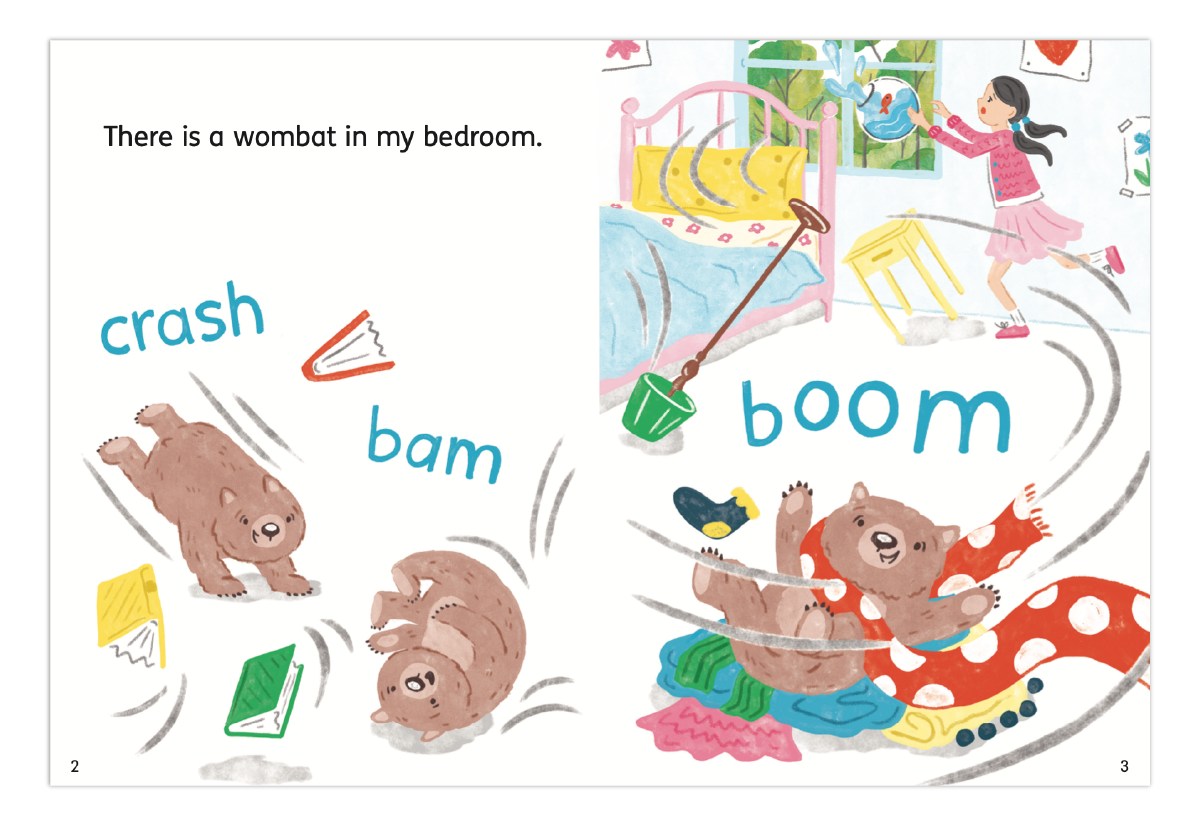
For example, on these pages, you could fluently and expressively say:
‘There is a wombat in my bedroom. Crash, bam, boom!’
Think-aloud strategies
Think-alouds are one of the most powerful tools in modelled reading. By pausing occasionally to verbalise your thoughts, you give students a glimpse into the cognitive processes skilled readers use automatically.
This might include:
- making predictions
- connecting the text to prior knowledge
- asking questions about the story
- pausing on unfamiliar words and saying, ‘I’m not too sure what that word means. Let’s come back to it at the end to see if we have more context later.’
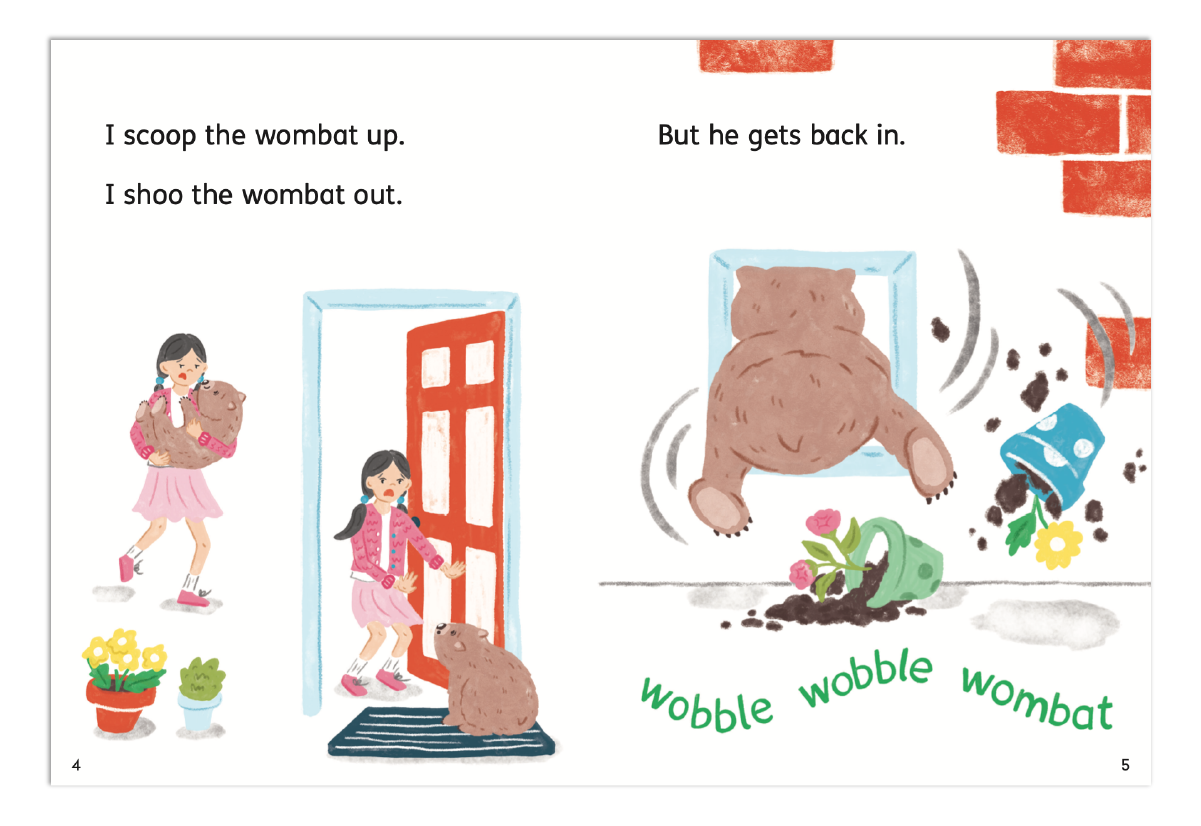
For example, on these pages you would read:
‘I scoop the wombat up. I shoo the wombat out. But he gets back in.’
And then say:
‘Ooo! This seems like a cheeky wombat, I wonder what will happen next?’
Spotlighting vocabulary
Beginning readers will encounter many unfamiliar words, or words used in new contexts. That’s why it’s important to explain unfamiliar vocabulary as it appears, to help students build language knowledge in meaningful contexts. Pointing out synonyms or providing simple definitions supports both vocabulary acquisition and comprehension.
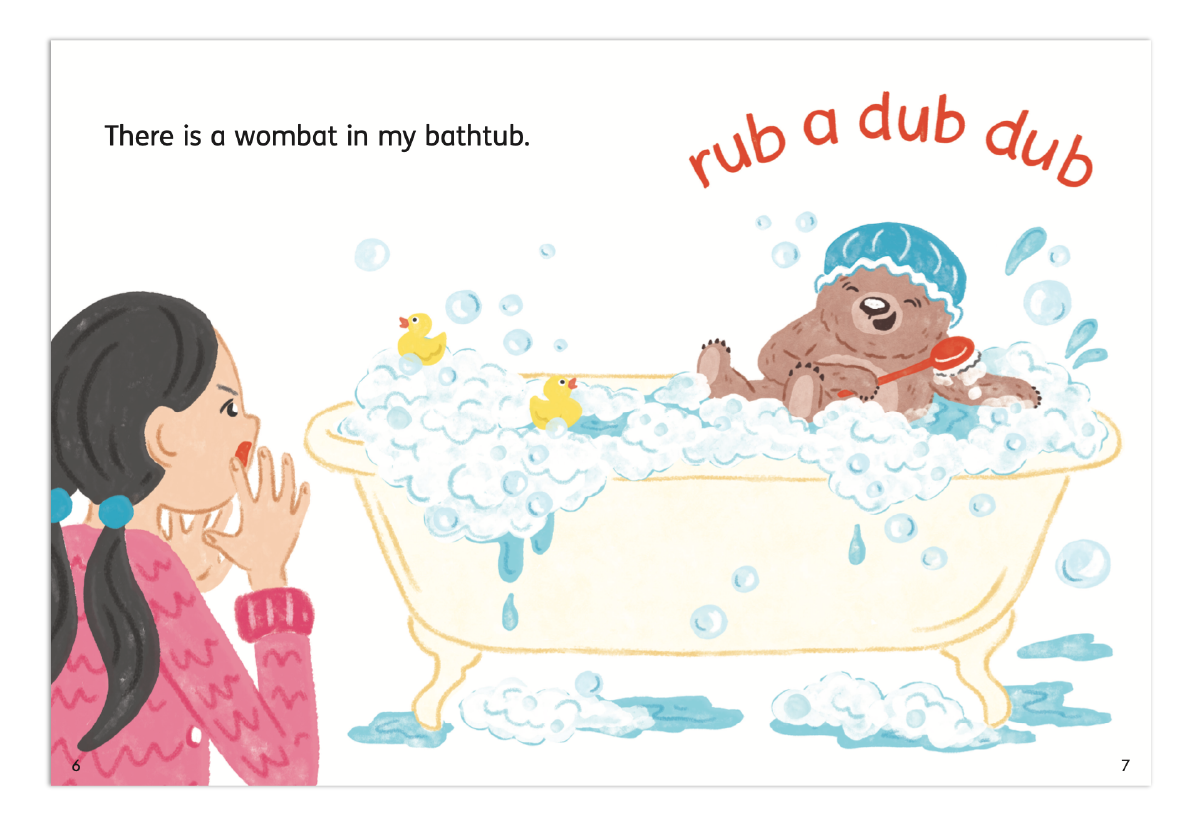
For example, on this page you would read:
‘There is a wombat in my bathtub. rub a dub dub.’
And then say:
‘Some of you might also call this a bath instead of a bathtub.’
Pointing out text features
Drawing attention to punctuation, headings, illustrations or repetitive sentence structures helps students use visual cues to support meaning.
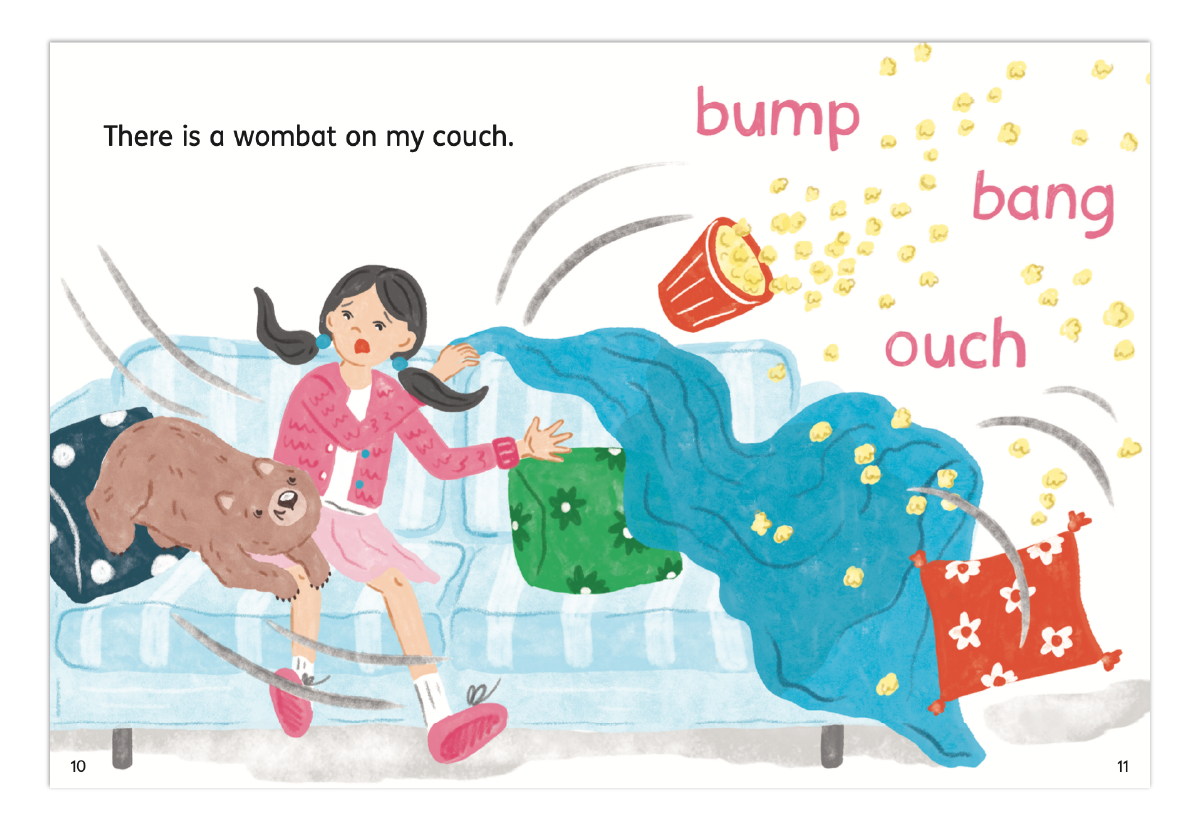
For example, on this page you would read:
‘There is a wombat on my couch. bump bang ouch’
And then say:
‘That rhymes! And what do we notice about the words bump, bang and ouch when we say them out loud? They sound like the noises they’re describing! Let’s keep reading and see if there are any more words like this.’
Engaging students through prediction
Inviting students to make quick predictions before turning a page or starting a new section keeps them active and invested in the story. This also reinforces key comprehension skills, encouraging students to look for clues and anticipate what might come next.
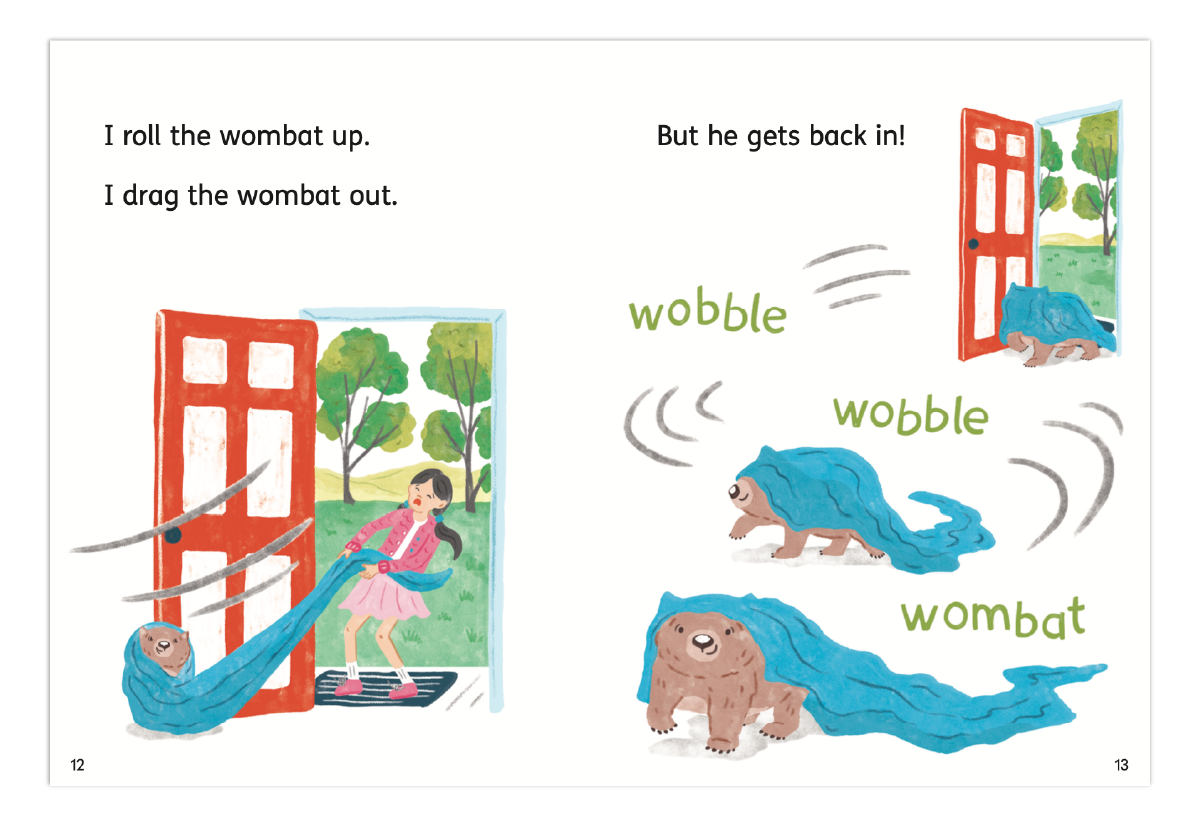
For example, on these pages you would read:
‘I roll the wombat up. I drag the wombat out.’
And then ask:
‘What do you think might happen next? Will the wombat stay outside?’
Modelling decoding skills
Although most modelled reading practice encourages fluent, continuous reading, it’s also helpful to include some demonstrations of decoding. Decoding words aloud through segmenting and blending shows students the strategies they can use to tackle unfamiliar words.
For example, on page 13 (above) you could say:
‘Hmm, this word looks tricky, let’s decode this word. /d/ /r/ a/ /g/ – drraaaggg – I drag the wombat out.’
Re-reading texts
Rather than trying to model every strategy in a single read, consider returning to the same text with a different focus each time. Varying your strategies across multiple reads isn’t just practical – it’s a strategy in itself.
How is modelled reading embedded in Sound Waves?
If you’re an early years teacher using Sound Waves, using the Sound Waves Decodable Readers forms an essential part of your weekly routine.
In Foundation and Year 1 Sound Waves lessons, use the projectable Decodable Readers in conjunction with your physical class sets for whole-class modelled and shared reading. The accompanying lesson guide includes handy tips for effective modelled reading, so you can quickly review some of these strategies before you begin.
If you’re interested to learn more about the Sound Waves Decodable Readers and how they are integrated into the Sound Waves program, contact your local education consultant to request a meeting or free professional learning workshop.