Articles & Videos
How phoneme and grapheme tips support orthographic mapping
Categories

Subscribe to our newsletters
Receive teaching resources and tips, exclusive special offers, useful product information and more!
How phoneme and grapheme tips support orthographic mapping
Sound Waves 5/5/26
Successful spellers rely on more than just a simple knowledge of phoneme–grapheme relationships. They understand why words are spelled a certain way through a deep knowledge of how words work.
When students are explicitly taught spelling patterns, they can make informed choices about which graphemes to use – and those choices stick. This is orthographic mapping in action, and it’s key to developing automaticity when reading and writing.
Take the word pack as an example. Why ck and not k or c? Because in pack the phoneme /k/occurs at the end of the word (not the beginning) and because it follows a short vowel sound. Once a student understands this tip, it provides them with a predictable pattern and suddenly a whole word family makes sense – pack, packing, packet, package.
A deep understanding of spelling patterns significantly contributes to a student’s writing capability. Instead of second-guessing every grapheme choice in a word, the simple application of orthographic knowledge enables students to confidently spell words with ease. This frees up their working memory to focus on ideas, creativity and meaning.
Did you know that Sound Waves includes powerful phoneme and grapheme tips in every unit? These carefully curated tips are a lifesaver for teachers and an invaluable tool for primary students as they journey along the complex process of learning to spell.
We’ve handpicked a few of our favourite tips including spelling patterns informed by suffixes, word origins and more:
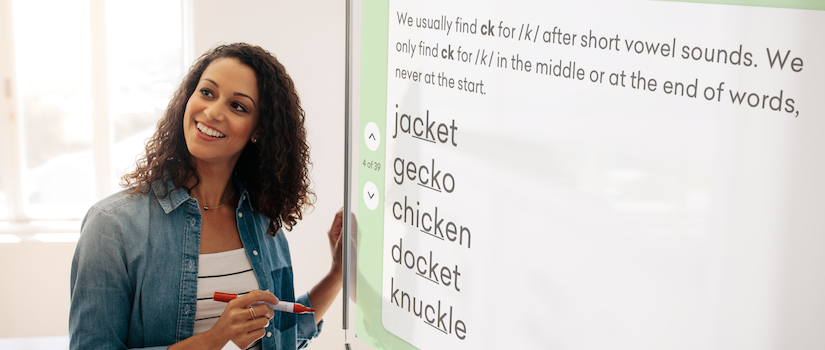
We usually find ck for /k/ after short vowel sounds. We only find ck for /k/ in the middle or at the end of words, never at the start (e.g. jacket, gecko, chicken, docket, knuckle).
We use ve for /v/ at the end of words (e.g. give, above, olive).
We usually find tch for /ch/ after short vowel sounds (e.g. catch, stretch, kitchen, watch, clutch).
We often use a for /o/ after /w/ (e.g. want, swamp, squash).
We usually find ss for /s/ after short vowel sounds (e.g. mass, address, bliss, blossom, discuss).
We usually find e_e for /ee/ in the final syllable of words (e.g. these, athlete, concrete).
We often use ie for /i_e/ when we add a suffix to words ending with y (e.g. cry – cried, fry – fried, reply – replies, supply – supplies).
We often use a for /ar/ before /s/ or /f/ (e.g. class, broadcast, after, giraffe).
We usually find sc for /s/ before e or i. Words containing sc for /s/ usually originate from Latin (e.g. science, scene, descend).
We usually use a for /or/ before /l/ (e.g. also, install, falling).
We only find gue for /g/ at the end of words. Words containing gue for /g/ usually originate from French (e.g. vague, fatigue, league).
We usually find ph for /f/ in words that originate from Greek (e.g. graph, sphere, hyphen).
Want more?
While these handy phoneme and grapheme tips have always been a staple in the Sound Waves Online unit resources, we’re excited to share that they will be front and centre in the new and improved Sound Waves Years 3–6 program – relaunching as Sound Waves Word Study!
By popular request, many of the phoneme and grapheme tips are now integrated as part of the lesson sequence, giving teachers a powerful framework to facilitate their direct instruction of spelling patterns. In addition, they’ll also be collated into a printable booklet – a handy reference tool for students and teachers alike!
The new edition Sound Waves Word Study will be available for use in classrooms in 2027. Can’t wait? Find out more today.