Articles & Videos
Can AI replace a structured program? Why scaffolded teaching still delivers better outcomes in primary classrooms
Categories

Subscribe to our newsletters
Receive teaching resources and tips, exclusive special offers, useful product information and more!
Can AI replace a structured program? Why scaffolded teaching still delivers better outcomes in primary classrooms
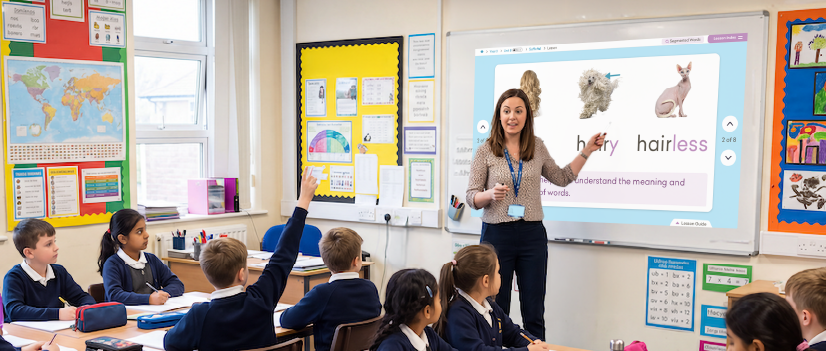
Teachers now have access to more AI tools than ever, most of which are developed to solve one problem well: draft a worksheet, mark an essay, generate a quiz. What is harder to find is an AI tool built around the full complexity of a real Australian classroom that caters for diverse learners and curriculum requirements, and includes lessons that build on each other week to week.
This is the gap that structured, scaffolded programs fill. The research consistently shows these programs outperform disconnected tools for one reason: learning is cumulative. We don’t need a different tool for every task – we need each learning component within a program to work towards the same goal.
What is the problem with isolated tools?
A tool that targets one skill in isolation can be useful — but without connection to the broader learning sequence, it rarely transfers. A student might practise skip counting through an app and perform well within that activity, yet struggle to apply the same thinking when solving multiplication problems in context.
Fragmented learning produces fragmented understanding.1 Students need to practise applying knowledge in varied, connected contexts repeatedly before it becomes genuinely usable.
Research suggests that when tools and programs are designed with cohesion, where each component connects to and builds on others, students engage more deeply, retain more and apply knowledge more effectively to new situations2 .
What makes a structured program effective?
Not all programs are created equal. The research is clear – structured approaches with meaningful integration produce deeper learning and better long-term outcomes than isolated, single-skill tools.
For primary educators looking to invest in something that will work across a full year, across a full cohort and across the full breadth of what students need, cohesion and intentional design are not optional extras – they are the foundation. A whole-school program that offers structured opportunities to develop content fluency, reasoning and problem-solving skills will support student success.
Why is a scaffolded approach essential?
Scaffolding is a deliberate evidence-based approach where students are guided from what they already know toward new, more complex understanding — with the level of support gradually reducing as confidence and competence grow.3
A systematic review of K–12 scaffolding studies found scaffolding of content had more impact on student outcomes than how much support was provided or when4. In other words, well-designed programs that scaffold the right concepts sequentially and intentionally outperform those that simply stack different tools together.
For primary classrooms, this matters enormously. When foundational skills like number sense or mental computation are built systematically, students don’t just learn the content — they develop the cognitive habits that make future learning stick. The Gradual Release of Responsibility model4 is a well-established approach that breaks complex concepts into smaller, manageable steps, providing scaffolding that is gradually removed as students gain confidence and expertise.
What does Gradual Release of Responsibility look like?
In the Gradual Release of Responsibility model of I do, We Do, You do, students move from explicit instruction, to guided practice, to independent application, progressing only when they are genuinely ready for the next step.
Each lesson, activity and assessment serves a specific purpose within a larger arc of learning. There are no gaps, no assumptions about what came before and no sudden leaps that leave students behind.
For teachers, this also means less planning burden. When a program is cohesively designed, educators aren’t left to fill the gaps themselves — the connections are already there.
What are the benefits for teachers?
In practical terms, a well-structured, scaffolded program should do several things at once: teach new content explicitly, reinforce prior learning, build toward the next stage and give teachers clear visibility over where each student sits in the sequence.
It should also align with the realities of Australian primary classrooms — the curriculum expectations, the student diversity and the time pressures that are part of every teacher’s day.
These are standards most AI tools simply aren’t built to meet. A well-designed program draws on deep knowledge and hands-on expertise from former educators who know exactly what a classroom needs. Built with that level of intentionality and backed by evidence, it doesn’t just support student learning, it makes teachers’ jobs genuinely easier. That is the approach behind all of Firefly Education’s literacy and numeracy programs.
References
- ZuoYuan, L, Samokhina, V & Sabirova, L 2025, ‘Motivational indicators and academic success in students: The impact of fragmented thinking’, Health Psychology Research, vol. 13, no. 2, ch e81240014↩
- Jacobs, HH 1989, Interdisciplinary curriculum: Design and implementation, Association for Supervision and Curriculum Development, Alexandria, VA↩
- Vygotsky, LS 1978, Mind in Society: The Development of Higher Psychological Processes, Harvard University Press, Cambridge, MA.↩
- Dominguez, S & Svihla, V 2023, ‘A review of teacher implemented scaffolding in K-12’, Social Sciences & Humanities Open, vol. 8, no. 1, https://doi.org/10.1016/j.ssaho.2023.100613↩