Articles & Videos
How to foster mathematical modelling skills using Maths Trek investigations
Categories

Subscribe to our newsletters
Receive teaching resources and tips, exclusive special offers, useful product information and more!
Back to Research & Case Studies articles & videos
How to foster mathematical modelling skills using Maths Trek investigations
Maths Trek 21/5/26
Education gives students the knowledge and skills they need to solve real-world problems,1 2 so for learning to become meaningful, it has to connect to the world beyond the classroom.3
Mathematical modelling is the bridge between theoretical mathematical concepts and real-world situations, and is an essential part of any maths education.1 4 5
Let’s learn more about mathematical modelling and explore how mathematical investigations can help to foster modelling skills in primary classrooms.
What is mathematical modelling?
Mathematical modelling is a cyclical process where students work towards applying maths concepts in real-world situations.2 First, students are taught new maths skills in a controlled environment where they are given the opportunity to achieve mastery through repeated practice. They are then tasked with applying these new skills in real-world scenarios. A successful modeller can recognise, connect and apply learned mathematical concepts to real situations and then reflect on the effectiveness of the maths.5
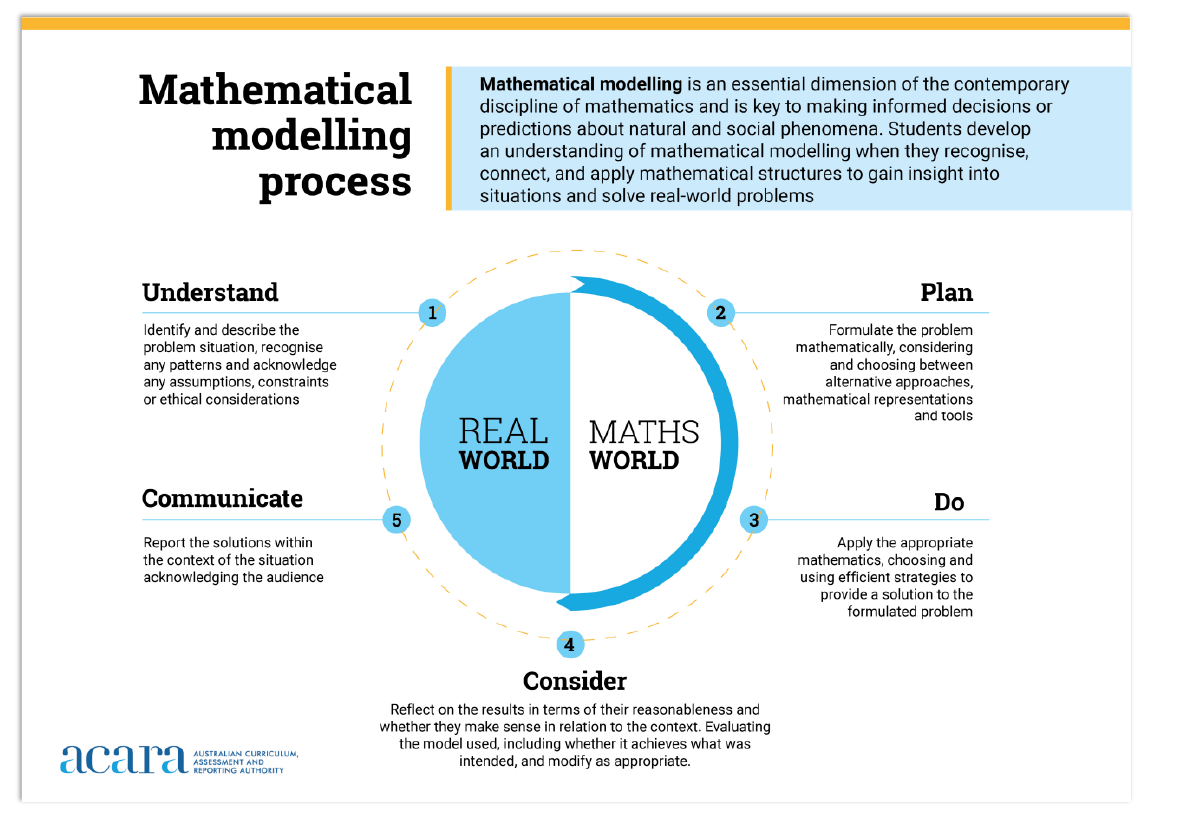
Figure 1: Mathematical modelling process from the Australian Curriculum v9.0
Why is mathematical modelling important in primary school classrooms?
As well as being a priority of the national and state curricula, competency in mathematical modelling is increasingly important for engaged participation in our personal and work lives.6 As indicated by the 2023 Trends in International Mathematics and Science Study (TIMSS) report, Year 4 students in Australia are able to demonstrate mathematical knowledge in simple situations or contexts but still need more experience with extended contexts.7 Giving students regular, focused opportunities to work through mathematical modelling is one of the most effective ways to shift that result.
How are mathematical investigations useful?
Mathematical investigations aim to explore extended real-world situations and provide the perfect platform for mathematical modelling. Investigations challenge students to select and apply a wide range of previously learned mathematical concepts and skills to an unfamiliar problem. This helps to connect different areas of mathematics, reinforce mathematical language and deepen a student’s understanding of concepts.8 When investigations are undertaken in a supportive classroom environment, they can encourage teamwork and discussion, foster curiosity and improve a student’s ability to apply mathematical knowledge to new situations.8
Maths Trek is a whole-school numeracy program for Foundation to Year 6 that embeds several investigations in the yearly plan for each year level. All Maths Trek investigations are week-long, whole-class activities that explore an extended real-world situation under the guidance of the classroom teacher. To complete an investigation, students need to identify the mathematics in the situation and apply previously learned rules or procedures to develop solutions, then critically evaluate their findings. The level of independent work within an investigation gradually increases from Foundation to Year 6 as students gain confidence in their own investigative and modelling skills.
How to foster modelling during investigations
To ensure investigations effectively support the development of mathematical modelling skills, there are a few key tips to keep in mind. Firstly, providing clear instructions or reminders can help students find focus, navigate through the modelling process and manage their time effectively.4 6 All Maths Trek investigations are broken down into logical and manageable steps that are supported by a comprehensive set of instructions and printable and projectable resources to help teachers guide their class through each step of the task.
Secondly, maximise engagement by ensuring students can relate to the mathematical context in some way. Throughout the course of each year, Maths Trek investigations cover a variety of contexts, from sport and travel to art, nature, puzzles and more. This variety is sure to appeal to most students in a class and will keep student engagement sustained throughout their maths lessons. And, of course, the general nature of investigations means they can be flexible. So if you and your students wish to take a different approach to any investigation, you can adapt it to suit students’ interests and proficiencies. The accompanying teacher observation rubric is also editible, which means you can still assess any altered investigations.
Thirdly, providing a solid introduction to the topic or task ensures prerequisite knowledge and experiences are addressed and reviewed if necessary. Each Maths Trek investigation comes with a list of prerequisite topics and an introduction lesson to project to the class.
Lastly, it is important to consider the amount of scaffolding provided throughout the task. Although an effective teacher should anticipate potential problems and be prepared to respond, it is important to provide measured guidance throughout all steps of an investigation to ensure students take an active roll in the modelling process.4 6 8 9 Scaffolding is built into all Maths Trek investigations in the form of guiding questions for discussion, differentiation tips and carefully curated prompts to support critical thinking steps.
Want more?
Discover more about the Maths Trek investigations in our investigation unit virtual tour:
Get started with a free trial of Maths Trek to explore a selection of the investigations for yourself!
References
Cevikbas, M, Kaiser, G & Schukajlow S 2021, ‘A systematic literature review of the current discussion on mathematical modelling competencies: state-of-the-art developments in conceptualising, measuring, and fostering’, Educational Studies in Mathematics, vol. 109, pp. 205-236, https://link.springer.com/article/10.1007/s10649-021-10104-6
Galbraith, P & Holton, D 2018, Mathematical Modelling: A guidebook for teachers and teams, Australian Council for Educational Research, Melbourne, viewed 5 May 2026, https://research.acer.edu.au/cgi/viewcontent.cgi?article=1001&context=mathematics
Vygotsky, LS 1997, Educational psychology, CRC Press LLC, Boca Raton, FL.
Lindl, A, Durandt, R & Blum, W 2025, ‘Fostering mathematical modelling competency in different learning environments and educational contexts – an exploratory comparative analysis of four intervention studies’, ZDM Mathematics Education, vol. 57, pp. 351-364, https://link.springer.com/article/10.1007/s11858-025-01680-5
Australian Curriculum, Assessment and Reporting Authority (ACARA) 2026, Understanding this learning area – Mathematics, viewed 5 May 2026, https://www.australiancurriculum.edu.au/curriculum-information/understand-this-learning-area/mathematics
Geiger, V, Galbraith, P, Niss, M & Holland-Twinning, B 2022, A typology for instructional enablers of mathematical modelling, Mathematics Education Research Group of Australasia (MERGA), viewed 5 May 2026, https://eric.ed.gov/?q=Promoting+a+Mathematical+Modelling+Culture+in+a+Queensland+School&id=ED623748
Wernert, N, Schmid, M & Rodrigues, S 2023, TIMSS 2023 Australia: Highlights on Australian student performance, Australian Council for Educational Research, viewed 5 May 2026, https://research.acer.edu.au/cgi/viewcontent.cgi?article=1001&context=timss_2023
Quinnell, L 2010, ‘Why are mathematical investigations important?’, Australian Mathematics Teacher, vol. 66, no.3, pp. 35-40, https://files.eric.ed.gov/fulltext/EJ898702.pdf
Fry, K, Hillman, J, Home, R & Rasmussen, E 2024, Mathematical modelling for a class party: challenges for students in one Year 4 classroom, Mathematics Education Research Group of Australasia (MERGA), viewed 5 May 2026 https://eric.ed.gov/?q=Fermi+problems+in+primary+mathematics+classrooms:+fostering+children’s+mathematical+modelling+processes&id=ED660989