Articles & Videos
How to choose a primary literacy program: What the research says
Categories

Subscribe to our newsletters
Receive teaching resources and tips, exclusive special offers, useful product information and more!
How to choose a primary literacy program: What the research says
Sound Waves 19/11/26
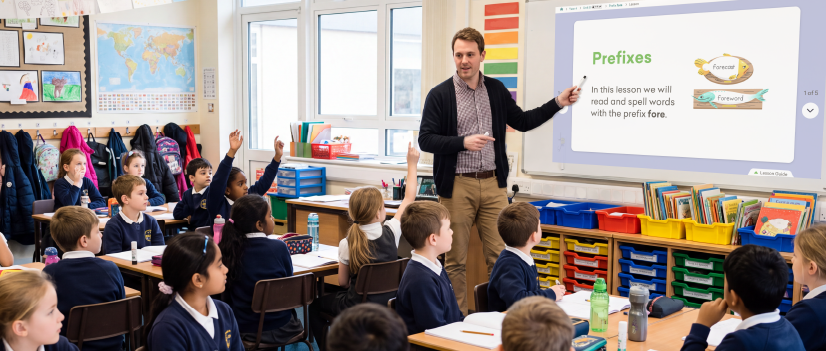
Choosing a literacy program is one of a school’s most important instructional decisions. The right program ensures consistency, teacher confidence and strong outcomes, providing a shared approach and a clear, connected path for students from Foundation to Year 6.
The good news is that the research on how children learn to read and spell is clearer than ever, giving school leaders and teachers solid criteria to evaluate programs and make confident decisions.
Here’s what to look for.
Start with what the research says
Most evidence-based literacy programs draw from a few well-established frameworks. Many educators are very familiar with the Simple View of Reading,1 which describes reading comprehension as the product of two skills: accurate word recognition and strong language comprehension. If one is weak, comprehension suffers.
Scarborough’s Reading Rope2 builds on this, showing how phonological awareness, decoding and sight word recognition become increasingly automatic, while vocabulary, background knowledge and language structures support increasingly strategic comprehension. Skilled reading develops when these strands weave together.
Major inquiries have reached consistent conclusions about early literacy. The US National Reading Panel,3 Australia’s National Inquiry into the Teaching of Literacy4 and the UK’s Rose Review5 all identified systematic, explicit phonics instruction as essential for beginning readers. More recently, the Australian Education Research Organisation (AERO)6 has reinforced the importance of explicit instruction and systematic synthetic phonics in Australian classrooms.
Importantly, researchers including Tessa Daffern,7 Rebecca Treiman8 and Dr Ken Rowe4 highlight the ongoing role of systematic synthetic phonics in literacy development throughout middle and upper primary, not just in the early years.
We also know from the work of Louisa Moats,9 Danielle Colenbrander10 and Tessa Daffern,7 among others, that a spelling program is incomplete without the inclusion of morphology, etymology and orthography.
Many evidence-informed programs now use a systematic synthetic phonics approach, incorporating morphology, etymology and orthography throughout their content. What sets programs apart is how well they support teachers to teach them and what they offer beyond the basic code as students progress through primary school.
Policy is aligned with the evidence too. Year 1 phonics checks are now used in public schools nationwide and non-government schools have committed to implementing them, which means early phonics knowledge is being measured more closely than ever.11
1. Is instruction systematic, sequential and explicit?
A strong program follows a planned scope and sequence, with each new concept building on prior learning. Skills are explicitly taught and modelled with regular opportunities for review and consolidation, so students aren’t left to work out the code themselves.
Look for a published scope and sequence you can read in full. Check that phoneme–grapheme relationships are introduced in a deliberate order, from simple to complex. Ensure that phoneme-grapheme relationships are regularly revisited and that students experiencing difficulty with these receive appropriate intervention.
Also consider lesson design. Strong programs follow a gradual release of responsibility, moving from explicit teacher modelling to guided practice and independent application.
2. Does it connect reading and spelling?
Reading and spelling are two sides of the same coin. Linnea Ehri’s12 research on orthographic mapping shows that students store words in long-term memory by connecting the sounds in a word to its letters. Once a word is mapped, it can be read automatically, freeing up cognitive resources for comprehension.
This means the strongest programs integrate spelling and reading rather than treating as isolated skills. They explicitly teach phoneme–grapheme relationships and give students opportunities to apply them in both directions: encoding (spelling) and decoding (reading). It is vitally important that consolidation tasks align closely with the lesson content.
In the early years, look for decodable readers that exactly align with the phonics sequence, so students practise reading texts built from the code they’ve been explicitly taught. Reference charts that show the common and less common graphemes for each phoneme are also valuable, helping students make accurate grapheme choices in their everyday writing.
3. Does it go beyond phonics to cover morphology and other word study concepts?
Systematic synthetic phonics is the foundation, not the finish line. As students move through middle and upper primary, they build on their phonics knowledge, drawing increasingly on knowledge of morphology (prefixes, suffixes, base words and Greek and Latin roots), etymology (word origins) and orthography (spelling patterns) to expand their vocabulary and spelling ability.
A systematic review by Bowers, Kirby and Deacon13 found that morphological instruction benefits literacy skills, particularly vocabulary and spelling. A word like biography becomes far easier to spell, read and understand once students know the Greek roots bio meaning life and graph meaning write.
Look for programs that introduce morphology early, ideally in Foundation and Year 1, and build complexity across the years. By Years 3 and 4, students should be exploring spelling patterns, word parts and word origins in greater depth.
4. Is the program written for Australian classrooms and mapped to curriculum requirements?
Look for programs with published alignment to the Australian Curriculum v9, plus state resources such as the Victorian Curriculum v2 or NSW syllabus. Ask program providers to show you exactly how their content maps to what you’re required to teach.
It is easy to overlook where the program was developed. Many phonics programs are developed and organised around American or British English, which differ from Australian English in vowel sounds and pronunciation.
Australian English has 43 phonemes. Programs for Australian classrooms should be organised around these phonemes and the graphemes used to represent them. When the sounds taught match the way students and their teachers actually speak, every lesson feels familiar and the code makes sense from day one.
5. Will the assessment actually inform your teaching?
There is little value in assessing for the sake of it! Assessment only matters when it leads to action. When evaluating a program, look for a mix of assessment types and a clear process for using results to guide intervention.
In the early years, that might include phonemic awareness assessments, which provide an early indication of foundational skills for spelling, alongside single-word reading assessments that show how well students recognise and decode words.
From Year 1 onwards, spelling diagnostic assessments at key points in the year (such as terms 1 and 3) help identify specific strengths and knowledge gaps. Regular content reviews, including single word and sentence dictation, show whether concepts are being retained over time rather than just remembered briefly and then forgotten.
Ask how results are captured and how they can be used to inform teaching and reporting. Marking guides, data spreadsheets and targeted remediation activities make the difference between assessment that sits in a folder and assessment that shapes next week’s teaching. Ensure the program allows time for assessment and follow-up.
6. Will it work across the whole school?
Whether you choose one program for all primary year levels or separate programs for Foundation to Year 2 and Years 3–6, you’ll want to ensure some level of continuity and consistency across the year levels.
Consistent language and lesson delivery create a shared approach between classrooms, and between teachers and students. This helps reduce gaps in learning, makes for smoother transitions between year levels and provides a clearer picture of each student’s progress. It also makes moderation, data conversations and professional learning far more productive.
A holistic approach does not mean the same content on repeat through the primary school years. It means teaching literacy as a connected set of skills, while ensuring that students’ developmental needs are prioritised, along with curriculum requirements. There is often a difference in literacy teaching between Foundation to Year 2, when students first learn to read and spell, and Years 3 to 6 where instruction should broaden and deepen as students come across increasingly complex vocabulary.
Teachers across all year levels should have a sense of the instruction their students have received in previous years along with a clear view of where student learning needs to go.
7. Does it support teachers and students?
The best program on paper won’t help if it’s impractical in a real classroom. Teacher workload is already significant, so a program should reduce planning time, not add to it.
Look for lessons designed for whole-class delivery with clear lesson guides, teaching tips and projectable resources. There’s a balance to strike here: fully scripted programs can feel rigid and undermine teacher judgement, while loose frameworks leave less confident teachers without enough support. Detailed, non-scripted guidance respects teacher expertise while ensuring consistency.
Differentiation matters too. Check what’s available for students who need more support: think targeted remediation activities, opportunities for review and practice, and games. Consider also those students ready for a challenge, who would benefit from extension words, extension tasks and challenge activities. Games, interactive tools and access to a range of printable resources can keep practice engaging without extra prep. These resources are often much-loved by students and can have the added benefit of providing teachers time to work with students who need additional support.
8. Is it engaging and appealing for students?
The best literacy lessons are the ones students genuinely look forward to. Engagement isn’t a nice optional extra – it’s part of what makes the learning stick.
Research supports this. A large meta-analysis by Toste et al.14 found a reciprocal relationship between reading motivation and reading achievement: motivated students read better and successful readers become more motivated. Rosenshine’s Principles of Instruction15 also highlight high success rates and active student participation as key to keeping students invested in their learning.
So when you’re reviewing a program, look at what students actually do during and after each lesson. Is there a clear I do, We do, You do approach? Are students responding, discussing and applying what they’ve learned or just listening and filling in worksheets?
Signs a program takes student engagement seriously:
- meaningful interactive tools built into the lesson sequence
- discussion prompts that encourage students to explore words, meanings and patterns
- small-group and whole-class games that turn practice into something students look forward to
- word origins and etymology that spark genuine curiosity about how language works
- enrichment activities and extension words to challenge capable students
- decodable texts that let early readers experience real success with books they can read independently
The last point matters more than it might seem. For a beginning reader, finishing a book on their own is a powerful moment. Programs that set students up for those early wins build confidence as well as skills.
For student engagement, design matters as much as content. Page layouts, lesson slideshows and online interfaces all influence student engagement. A well-designed program holds students’ interest without distracting from the learning and it keeps the cognitive load low so students can focus on the content.
When trialling a new program, a useful test is to ask teachers how students respond after a few weeks. If students are asking to play the games again or pointing out spelling patterns in their own reading, that’s a strong signal you’re onto a winner.
9. Does the program include professional learning support?
Finally, ask about professional learning. Consistent implementation depends on teachers understanding the why and the what behind the program. Quality professional learning should be flexible and tailored to teachers’ needs.
Look for a range of professional learning options to suit your school, including Education Consultants who will attend leadership meetings and conduct in-depth tailored workshops through to informal check-ins once teaching is underway. Ongoing support, ideally at no extra cost, is a strong sign that a provider is invested in your school’s success beyond the initial purchase.
A quick evaluation checklist
- Can we see the full scope and sequence?
- Are reading and spelling taught together, with decodable texts in the early years?
- Does every explicit lesson include ready-made consolidation that aligns with the lesson content?
- Does morphology and etymology build across the years?
- Is it written for Australian classrooms and mapped to curriculum requirements?
- Does assessment lead directly to remediation?
- Does it fit with our whole-school goals from Foundation to Year 6?
- Is it practical for teachers and students?
- Will students be actively engaged and motivated?
- Can we explore the resources in-depth before committing?
- What professional learning is included, and what does it cost?
Take the next step
Developed by linguistic experts and experienced teachers for Australian classrooms, Sound Waves Early Literacy (F–2) and Sound Waves Word Study (3–6) tick all the boxes! They combine established research on how students learn to read and spell with decades of real classroom experience.
To discover why Sound Waves is the right choice for your school, book a session with your local Education Consultant. With their wealth of knowledge and teaching experience, our team can answer any questions you have about the program’s resources and how best to implement them in your classroom.
References
Gough, PB & Tunmer, WE 1986, ‘Decoding, reading, and reading disability’, Remedial and Special Education, vol. 7, no. 1, pp. 6-10, https://doi.org/10.1177/074193258600700104↩
Scarborough, HS 2001, ‘Connecting early language and literacy to later reading (dis)abilities: Evidence, theory, and practice’, in SB Neuman & DK Dickinson (eds), Handbook of early literacy research, Guilford Press, New York↩
National Reading Panel 2000, Teaching children to read: An evidence-based assessment of the scientific research literature on reading and its implications for reading instruction, National Institute of Child Health and Human Development, Washington, DC↩
Rowe, KJ 2005, Teaching reading: Report and recommendations, Department of Education, Science and Training: National Inquiry into the Teaching of Literacy, https://research.acer.edu.au/cgi/viewcontent.cgi?article=1004&context=tll_misc↩
Rose, J 2006, Independent review of the teaching of early reading, U.K. Department for Education and Skills, https://dera.ioe.ac.uk/5551/2/report.pdf↩
Australian Education Research Organisation (AERO) 2023, Introduction to the science of reading, https://www.edresearch.edu.au↩
Daffern, T 2017, ‘Linguistic skills involved in learning to spell: An Australian study’, Language and Education, vol. 31, no. 4, pp. 307-329, https://doi.org/10.1080/09500782.2017.1296855↩
Treiman, R 2018, ‘Statistical learning and spelling’, Language, Speech, and Hearing Services in Schools, vol. 49, no. 3S, pp. 644-652, https://doi.org/10.1044/2018_LSHSS-STLT1-17-0122↩
Moats, LC 2005, ‘How spelling supports reading and why it is more regular and predictable than you may think’, American Educator, vol. 6, pp. 12-43, https://www.folkeskolen.dk/wp-content/uploads/2025/05/Moats-1.pdf↩
Colenbrander, D, von Hagen, A, Kohnen, S, Wegener, S, Ko, K, Beyersmann, E, Behzadnia, A, Parrila, R & Castles, A 2024, ‘The effects of morphological instruction on literacy outcomes for children in English-speaking countries: A systematic review and meta-analysis’, Educational Psychology Review, vol. 36, no. 119, https://doi.org/10.1007/s10648-024-09953-3↩
Australian Government Department of Education 2026, ‘The Better and Fairer Schools Agreements Progress Report’, July 2026, https://www.education.gov.au/download/20250/better-and-fairer-schools-agreements-progress-report-march-2026/44340/document/pdf↩
Ehri, LC 2014, ‘Orthographic mapping in the acquisition of sight word reading, spelling memory, and vocabulary learning’, Scientific Studies of Reading, vol. 18, no. 1, pp. 5-21, https://doi.org/10.1080/10888438.2013.819356↩
Bowers, PN, Kirby, JR & Deacon, SH 2010, ‘The effects of morphological instruction on literacy skills: A systematic review of the literature’, Review of Educational Research, vol. 80, no. 2, pp. 144-179, https://doi.org/10.3102/0034654309359353↩
Toste, JR, Didion, L, Peng, P, Filderman, MJ & McClelland, AM 2020, ‘A meta-analytic review of the relations between motivation and reading achievement for K–12 students’, Review of Educational Research, vol. 90, no. 3, pp. 420-456, https://doi.org/10.3102/0034654320919352↩
Rosenshine, B 2012, ‘Principles of instruction: Research-based strategies that all teachers should know’, American Educator, vol. 36, no. 1, pp. 12-19, https://files.eric.ed.gov/fulltext/EJ971753.pdf↩