Articles & Videos
Daily reviews: The science of spaced, interleaved and retrieval practice
Categories

Subscribe to our newsletters
Receive teaching resources and tips, exclusive special offers, useful product information and more!
Back to Product Features articles & videos
Daily reviews: The science of spaced, interleaved and retrieval practice
Maths Trek 30/7/26
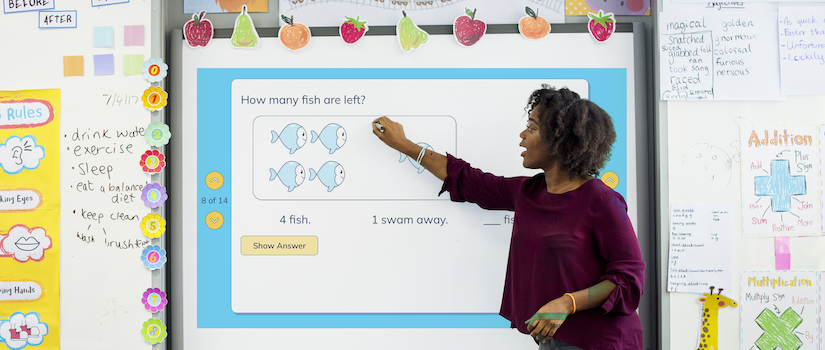
There’s a growing body of research on how students learn best, and it has a lot to say about what should happen in the first few minutes of a maths lesson. These findings are what shaped the new Daily Reviews at Maths Trek Online. In this article, we look at what that research says and what it means for your maths lessons.
We’ve all heard the expression ‘practice makes perfect’, but did you know that spaced, interleaved and retrieval practices can significantly improve memory, retention of information, problem-solving skills and transfer skills?1 2 3 4 Research shows that the right kind of practice can help students to consolidate their understanding and develop automaticity which leads to improved educational outcomes over time2 5 6 7.
Spaced, interleaved and retrieval practice – what are they?
Before understanding how daily reviews form a valuable part of your maths routine, first we need to unpack these three key terms and research behind their application.
Spacing is a method of learning where a particular topic is purposefully spread over several lessons rather than covered in one continuous session (massed practice)8.
Retrieval is the practice of recall, where students are actively required to bring information to the forefront of their minds otherwise known as working memory8. If we combine the two, spaced retrieval practice involves revisiting previously learned content after an intentional delay period. Research shows that spaced retrieval practice improves the retrievability of information by strengthening neural pathways6 9 10, which leads to improved memory and retention, and eventually automaticity – the ability to perform tasks quickly or easily without conscious energy. Automaticity is a desirable trait for any student as it can help to reduce the cognitive load of new learning by keeping the working memory free5. This helps students to make stronger connections between topics, apply higher-order skills or solve problems1 2 9.
Interleaving is the process of covering or blending a range of different topics in one session, as opposed to a single topic (blocked practice)11 12.
This method of practice requires students to actively retrieve and use a range of information to answer questions, which not only consolidates the information but also strengthens discrimination and transfer skills12. Interleaved practice is also shown to have a greater impact on memory, retention and problem-solving skills than blocked practice12.
Though there are clear benefits when it comes to incorporating spacing, interleaving and retrieval, the delay period between repeated practice is also important. Research suggests that a longer delay (e.g. a week or longer) is more beneficial than a shorter delay (e.g. a day) and the expansion of subsequent delays over time may lead to long-term retention of information13. On the flip side, very short delays (especially those combined with massed and blocked practice) were found to cause overconfidence and create an illusion of mastery, which may lead to poor metacognitive awareness2.
How can daily reviews improve educational outcomes?
What are daily reviews?
Daily reviews are short, regular, teacher-led activities designed to review previously learned content and are often used as a warm-up for an upcoming lesson. They often include fact retrieval and skill rehearsal, but can range in question type and difficulty.
Why are daily reviews important?
With appropriate planning and good writing, daily reviews can be a light and friendly way to include spaced retrieval practice with suitable delays, whilst also allowing for interleaved practice if questions vary in topic or strand13. A daily review should offer:
- regular repeated practice of retrieval skills
- appropriate spacing
- review of multiple topics
- a quick, low-entry activity suitable for a range of ability levels13.
What are the benefits of completing daily reviews?
Daily reviews can achieve optimal results if they are also designed for high participation13. High participation indicates the content is specifically targeted at a level that you would expect 80% of students to be able to confidently and quickly answer14. This can be achieved by using activities that invite:
- whole class participation
- choral responses
- short written responses on whiteboards
- multiple choice or short response answers.
Daily reviews can also provide both teachers and students with useful information about how well class material has been learned and retained, which results in improved metacognitive awareness2 8. Teachers and students can use this information to make adjustments to address gaps or misconceptions, and undertake further practice or study if required13.
Maths Trek Daily Reviews for every topic – new feature!
Daily reviews are available in every topic lesson from Foundation to Year 6 at Maths Trek Online.
Maths Trek Daily Reviews are short, online slideshows curated to review previously learned content and prepare students for the upcoming lesson. They typically include 10–12 simple questions that review the previous topic, as well as topics from 4–6 weeks prior, and take about 5-10 minutes to complete. This allows for the repeated exposure of content while targeting the delayed and spaced retrieval skills required to retain information and build mathematical fluency.
The Daily Reviews predominantly cover Number or Algebra topics and general numeracy skills, but also address Measurement, Space, Statistics and Probability concepts, providing many opportunities for interleaved practice. Most questions require short verbal responses but may also require chanting, physical movements, short written responses, simple drawings or the manipulation of concrete materials (e.g. counters).
References
- Kang, SHK 2016, ‘Spaced repetition promotes efficient and effective learning: Policy implications for instruction’, Policy Insights from the Behavioural and Brain Sciences, vol. 3, no. 1, pp. 12-19, doi: 10.1177/2372732215624708↩
- Emeny, WG, Hartwig, MK & Rohrer, D 2021, ‘Spaced mathematics practice improves test scores and reduces overconfidence’, Applied Cognitive Psychology, vol. 35, no. 4, pp. 1082-1089, viewed 20 July 2026, https://psycnet.apa.org/doi/10.1002/acp.3814↩
- Carpenter, SK, Pan, SC & Butler, AC 2022, ‘The science of effective learning: Spacing, retrieval practice, and metacognition of strategy use’, Nature Reviews Psychology, vol. 1, pp. 496-511, https://www.nature.com/articles/s44159-022-00089-1↩
- Samani, J & Pan, SC 2021, ‘Interleaved practice enhances memory and problem-solving ability in undergraduate physics’, NPJ Science of Learning, vol. 6, no. 32, doi: 10.1038/s41539-021-00110-x↩
- Merlo, S 2024, The science of mathematics and how to apply it, Analysis Paper 71, The Centre for Independent Studies, viewed 21 July 2026, https://www.cis.org.au/wp-content/uploads/2024/07/AP71-Science-of-Maths-2.pdf↩
- Australian Education Research Organisation (AERO) 2025, Retention and recall: Students process limited amounts of new information, viewed 21 July 2026, https://www.edresearch.edu.au/sites/default/files/2025-04/retention-and-recall-explainer-aa.pdf↩
- Carmack, L 2022, ‘Incorporating lessons from cognitive science: Spacing and mixing in mathematics homework assignment design’, PRIMUS, vol. 32, no. 9, pp. 939-949, doi: 10.1080/10511970.2021.1945718↩
- Australian Education Research Organisation (AERO) 2021, Spacing and retrieval practice: Improve students’ long-term retention of learning, viewed 21 July 2026, https://www.edresearch.edu.au/sites/default/files/2021-09/tried-tested-spacing-retrieval-practice-aero.pdf↩
- Australian Education Research Organisation (AERO) 2024, Vary practice: Space and vary tasks for guided and independent student practise, viewed 21 July 2026, https://www.edresearch.edu.au/sites/default/files/2024-11/AERO-practice-guide-vary-practice-aa.pdf↩
- Santoro, H 2021, The neuroscience behind the spacing effect, viewed 21 July 2026, https://www.brainfacts.org/thinking-sensing-and-behaving/learning-and-memory/2021/the-neuroscience-behind-the-spacing-effect-030421↩
- Morkunas, D 2020, ‘Spaced, interleaved and retrieval practice: The principles underlying the daily review’, Learning Difficulties Australia Bulletin, viewed 21 July 2026, https://ldaustralia.org/wp-content/uploads/2021/03/Morkunas-Spaced-interleaved-and-retrieval-practice.pdf?ref=on.dystinct.org ↩
- Sarmani, J & Pan, SC 2021, ‘Interleaved practice enhances memory and problem-solving ability in undergraduate physics’, NPJ Science of Learning, vol. 6, no. 32, doi: 10.1038/s41539-021-00110-x↩
- Australian Education Research Organisation (AERO) 2024, Revisit and review: Regularly revisit and review learning, viewed 21 July 2026, https://www.edresearch.edu.au/sites/default/files/2024-11/AERO-practice-guide-revisit-and-review-aa.pdf↩
- Department of Education and Training, State of Victoria, 2020, High Impact Teaching Strategies: Excellence in Teaching and Learning, https://www.education.vic.gov.au/Documents/school/teachers/support/high-impact-teaching-strategies.pdf↩