Articles & Videos
How to successfully apply High Impact Teaching Strategies in your maths lessons
Categories

Subscribe to our newsletters
Receive teaching resources and tips, exclusive special offers, useful product information and more!
Back to Research & Case Studies articles & videos
How to successfully apply High Impact Teaching Strategies in your maths lessons
Maths Trek 21/5/26

A universal goal that all teachers share is to maximise knowledge retention in students. In other words, to make sure learning really sticks. In maths, this is particularly important as many concepts are cumulative and growth depends on the mastery of prerequisite skills.
High Impact Teaching Strategies (HITS) are ten evidence-based practices that teachers can apply to increase student learning.1 They emerged from research into effective instruction and give educators a road map to improve student outcomes.
The ten strategies are:
- Setting goals
- Structuring lessons
- Explicit teaching
- Worked examples
- Collaborative learning
- Multiple exposures
- Questioning
- Feedback
- Metacognitive strategies
- Differentiated teaching
So let’s find out how you can use these strategies to support your students in maths, and how the Maths Trek program can help you achieve this.
1. Setting goals
Effective lessons begin by establishing a clear outline of the learning intention, as well as clarification of what success looks like for students. Having clear learning goals helps the teacher to plan learning activities and helps students understand what is required.2
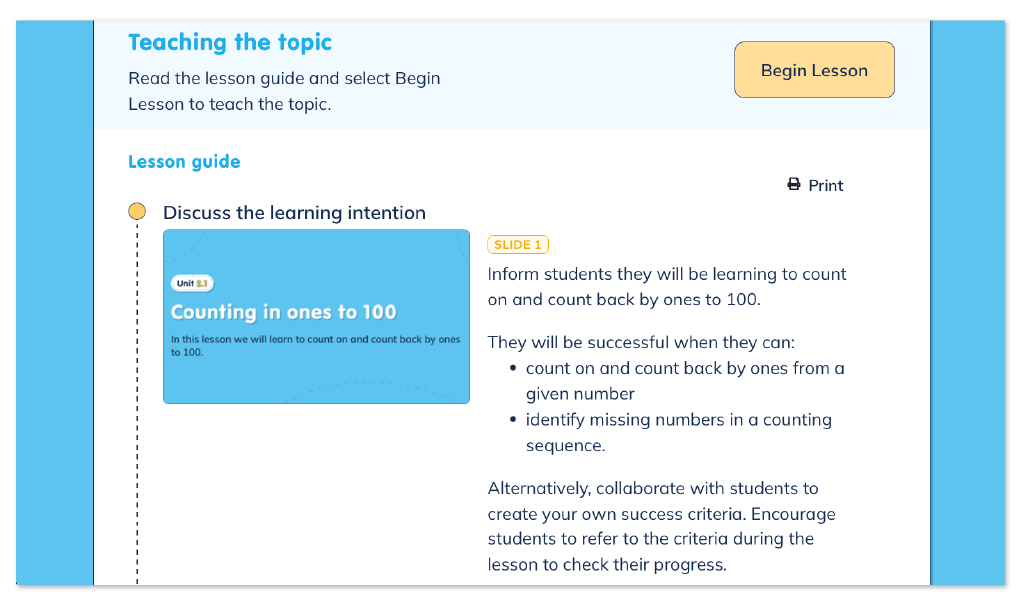
Maths Trek provides a succinct learning intention and success criteria for every topic lesson. The projectable lesson slideshow guides teachers to discuss these elements with their students to ensure that everyone understands the outcomes of the lesson ahead.
Here’s an example from Year 1, Unit 2.1 Counting in ones to 100.
2. Structuring lessons
Well-structured maths lessons order activities so that all students are supported to achieve success. Maths Trek lessons are designed based on the Gradual Release of Responsibility 3 model of I Do, We Do, You Do. This instructional framework allows for explicit teaching, guided rehearsal and independent practice to take place within each lesson. The Gradual Release of Responsibility model has been shown to improve the mathematical performance of students and help to increase their self-efficacy.3
In Maths Trek, this approach unfolds through this typical lesson sequence:
- first, teach the concept using the explicit teaching slides (supported by the lesson guide)
- then, work through the worked examples as part of guided instruction
- finally, move students on to the Student Book activities for consolidation and independent practice.
3. Explicit teaching
Explicit teaching is the practice of showing students what to do and how to do it. This is done best when it is implemented in a systematic and sequential way, with clear instruction and demonstration of concepts by the teacher.4
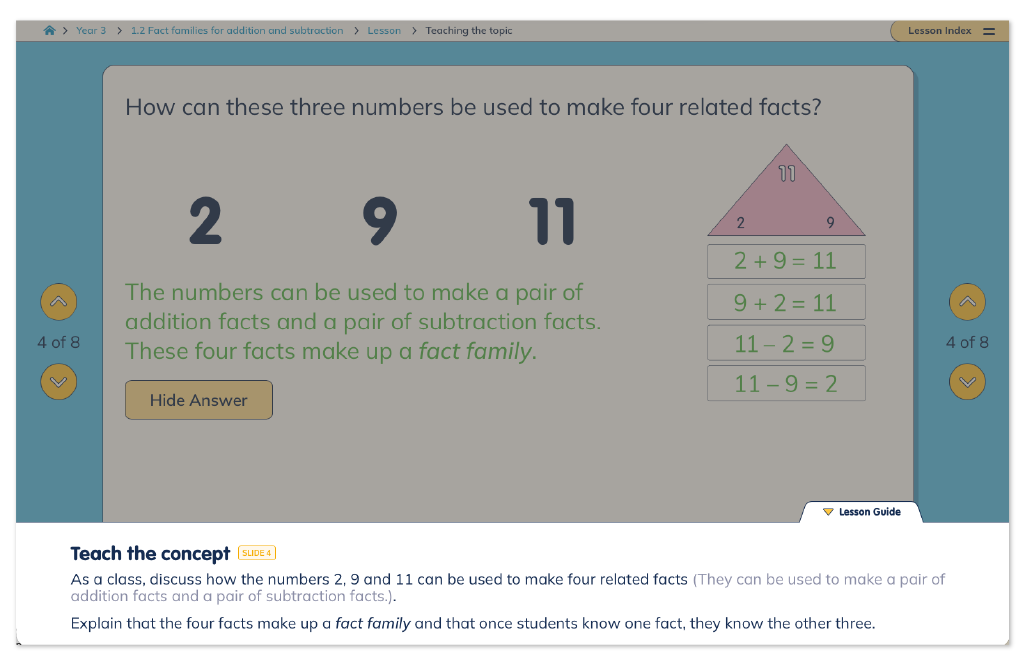
Maths Trek provides explicit teaching slides for every topic and problem-solving strategy lesson that step out the learning. These are supported by detailed teaching notes, all written by maths content experts.
Here’s an example from Year 3, Unit 1.2 Fact families for addition and subtraction.
4. Worked examples
A worked example is a demonstration of the steps required to complete a task or solve a problem.1 Effective models and worked examples help reduce the cognitive load for students when learning new information, allowing them to focus on the specific steps to solve problems.
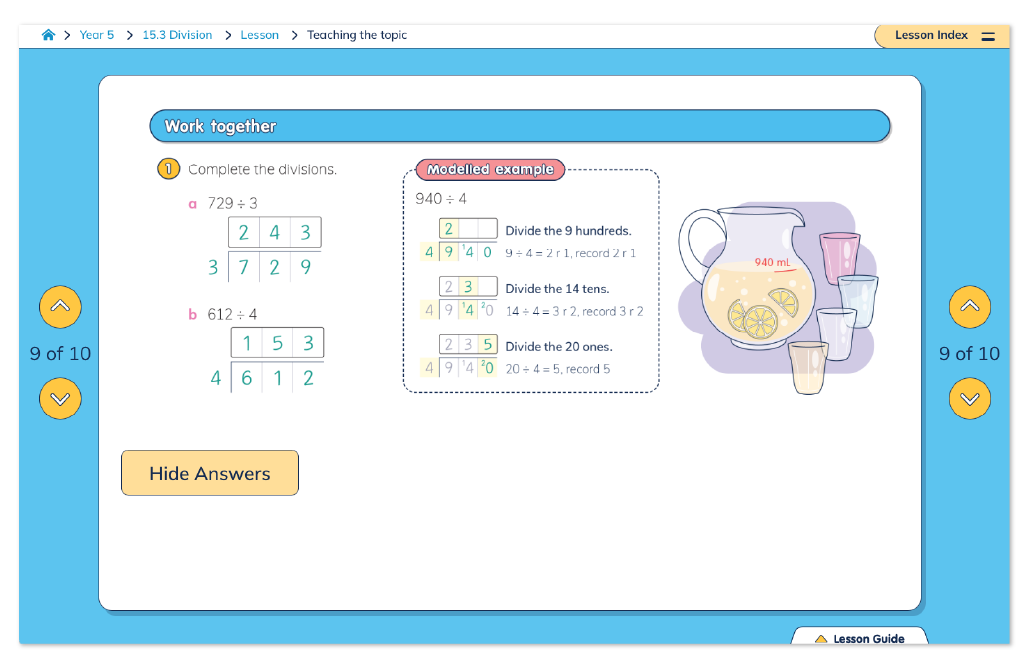
Providing models and worked examples is one of Barak Rosenshine’s 10 Principles of Effective Instruction5, drawn from research into cognitive science and observation of the classroom practice of master teachers. Maths Trek includes ready-made worked examples to provide effective cognitive support for students – and to decrease teacher workload. While Rosenshine’s principles can be applied to any subject, this particular principle is imperative for teaching maths and with Maths Trek it’s embedded in all maths lessons.
Here’s an example from Year 5, Unit 15.3 Division.
5. Collaborative learning
Collaborative learning occurs when teachers provide students with opportunities to cooperate with their peers on meaningful tasks. Educational researcher Professor Catherine Attard states that mathematics isn’t simply about content knowledge but about providing children with opportunities to explore, investigate and problem solve.6
In Maths Trek, collaborative learning and mathematical exploration go hand in hand. The program includes rich investigations that give students the opportunity to apply what they’ve learned in real-world contexts. For example, the Year 1, Term 1 investigation Ramp Champ asks students to work with their peers to extend the distance a toy car will travel based on changed conditions such as a steeper ramp.
Additionally, students have many opportunities to collaborate in the We Do part of lessons, as well as in mathematical games to consolidate their knowledge.
6. Multiple exposures
Students require multiple opportunities to engage with a concept before it is transferred to their long-term memory.1 This method of teaching is often referred to as spaced retrieval practice and research shows that it greatly increases learner retention1.
Maths Trek successfully embodies this method and including multiple exposures of content has received positive feedback from Australian schools using the program. Teachers at Roleystone Community College praise the program, especially the ‘scaffolded learning in steps to help support concepts for the kids’. After six months using the program, staff at Whitford Catholic Primary School reported ‘deeper learning and increased retention’ among students, saying that the way Maths Trek ‘revisits concepts to embed knowledge’ is a stand-out aspect of the program.
Read our article to learn more about the way spaced and interleaved practice is optimised within Maths Trek.
7. Questioning
Effective questioning supports students to demonstrate their learning, make connections to their lives and collaborate with their peers. It also acts as a powerful and immediate opportunity for teachers to formatively assess student understanding.
Maths Trek offers ample opportunities for questioning in topic and problem-solving lessons, during investigations and in the ‘think critically’ section of problem-solving practice units. Targeted questions are also provided in lesson plans, saving teachers valuable time. Here is an example from the Year 6, Term 3 investigation Fantasy flight.
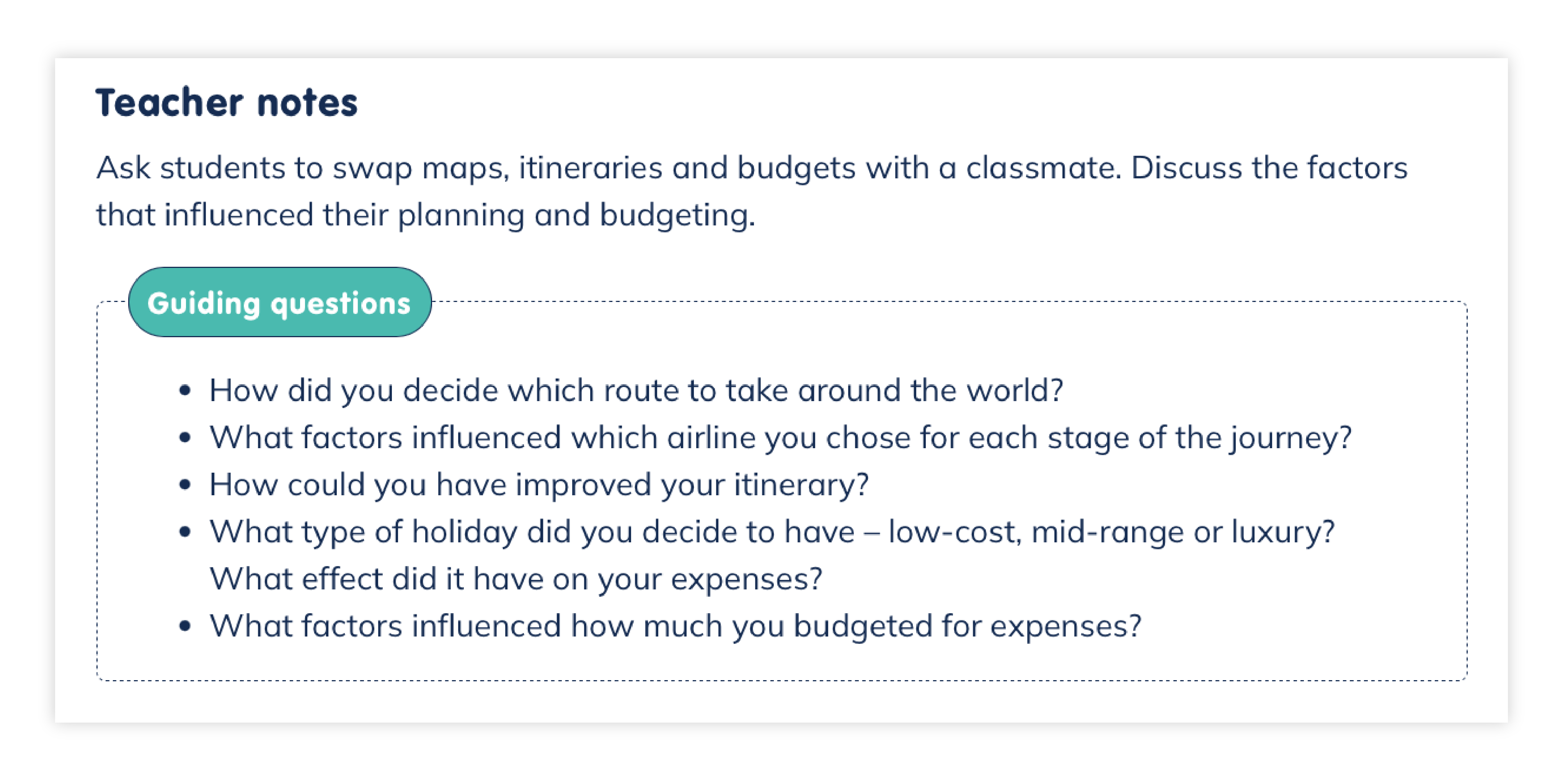
Students are tasked with planning a dream trip around the world using 50 000 km of free air travel before comparing their work with a classmate. Teachers are given a list of guiding questions to support students to do this effectively and to gauge their level of understanding.
8. Feedback
Purposeful and timely feedback helps to improve learning. When students receive specific, accurate and clear feedback that focuses on the task at a hand it has been shown to increase their performance.
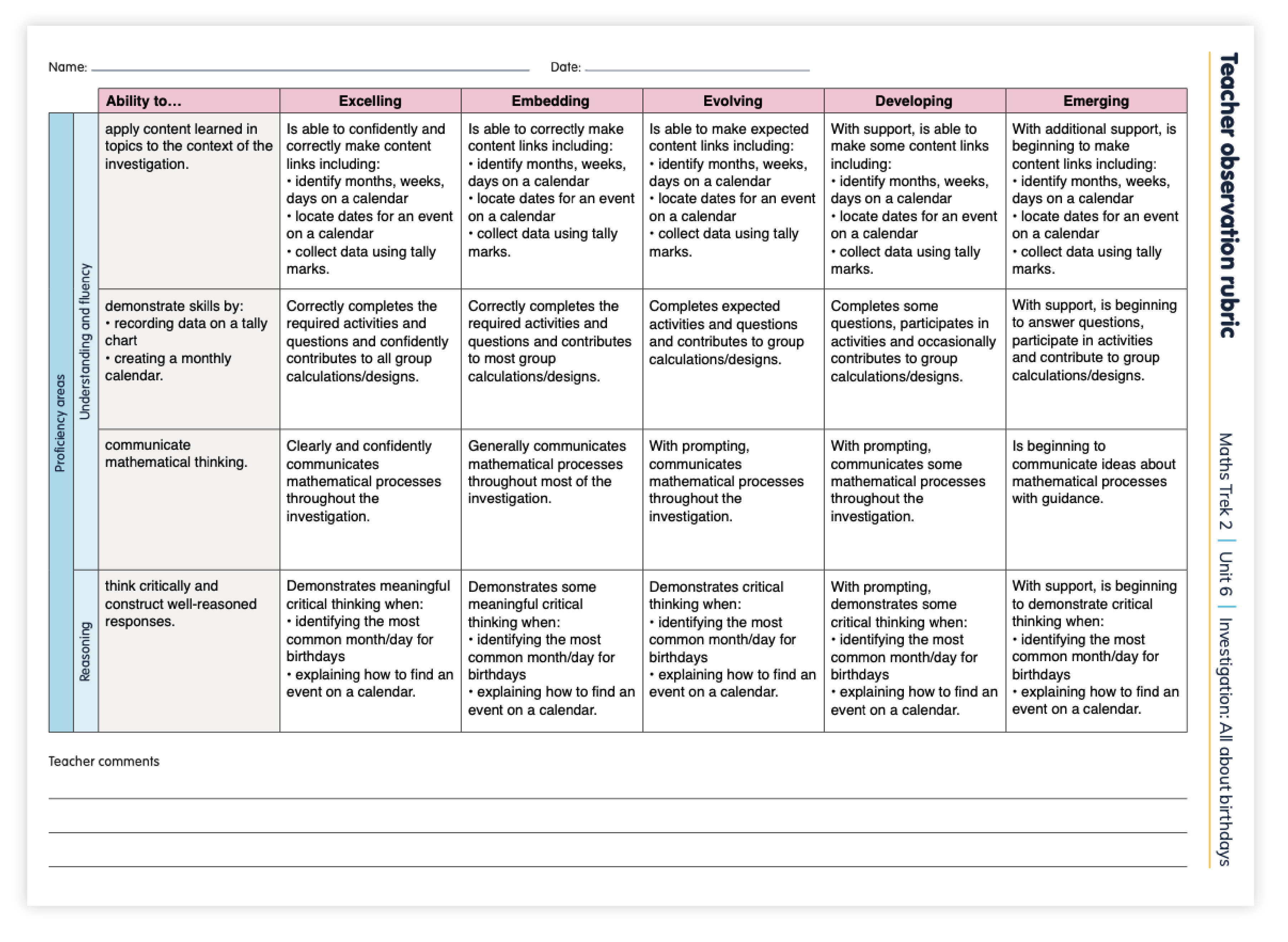
Maths Trek gives teachers many opportunities to offer feedback to students. Within daily topic lessons, teachers have the option to show answers for class marking and to address misconceptions before students apply their learning independently. The Daily Number Practice tool gives students immediate feedback on whether their answers to fluency questions are correct. The summative topic assessments come with a data spreadsheet so teachers can easily determine student progress and provide specific feedback based on this. And lastly, each investigation comes with a teacher observation rubric so progress is made clear to students.
Here’s an example of a rubric from the Year 2, Term 1 investigation All about birthdays.
9. Metacognitive strategies
Metacognition is the process of thinking about one’s own thinking. Effective teachers help students develop metacognitive strategies so they have an awareness of the way they learn. It is the process that empowers students to take responsibility for their own learning.
Maths Trek aids this process in many ways, including explicit teaching and modelling of problem-solving strategies. There are 9 consistent strategies taught from Years 1–6, as well as problem-solving practice units in which students are encouraged to choose which strategy or combination of strategies would be best suited to the problem at hand. Maths Trek also provides critical thinking lessons where students are guided to apply cognitive verbs to move from stimulus to solution. These activities, plus many more, support students to develop their metacognitive skills and consider their own mathematical thinking.
10. Differentiated teaching
The final strategy in the HITS framework is differentiation – a common practice whereby teachers provide opportunities for appropriate challenge for all students in the class based on their abilities, interests and learning profile. When implemented effectively, differentiated teaching enables all students to engage meaningfully with challenging mathematical content, make progress in their learning and achieve their potential as mathematical learners.7
Maths Trek has built-in differentiation features that teachers can use in addition to the general differentiation they do every day.
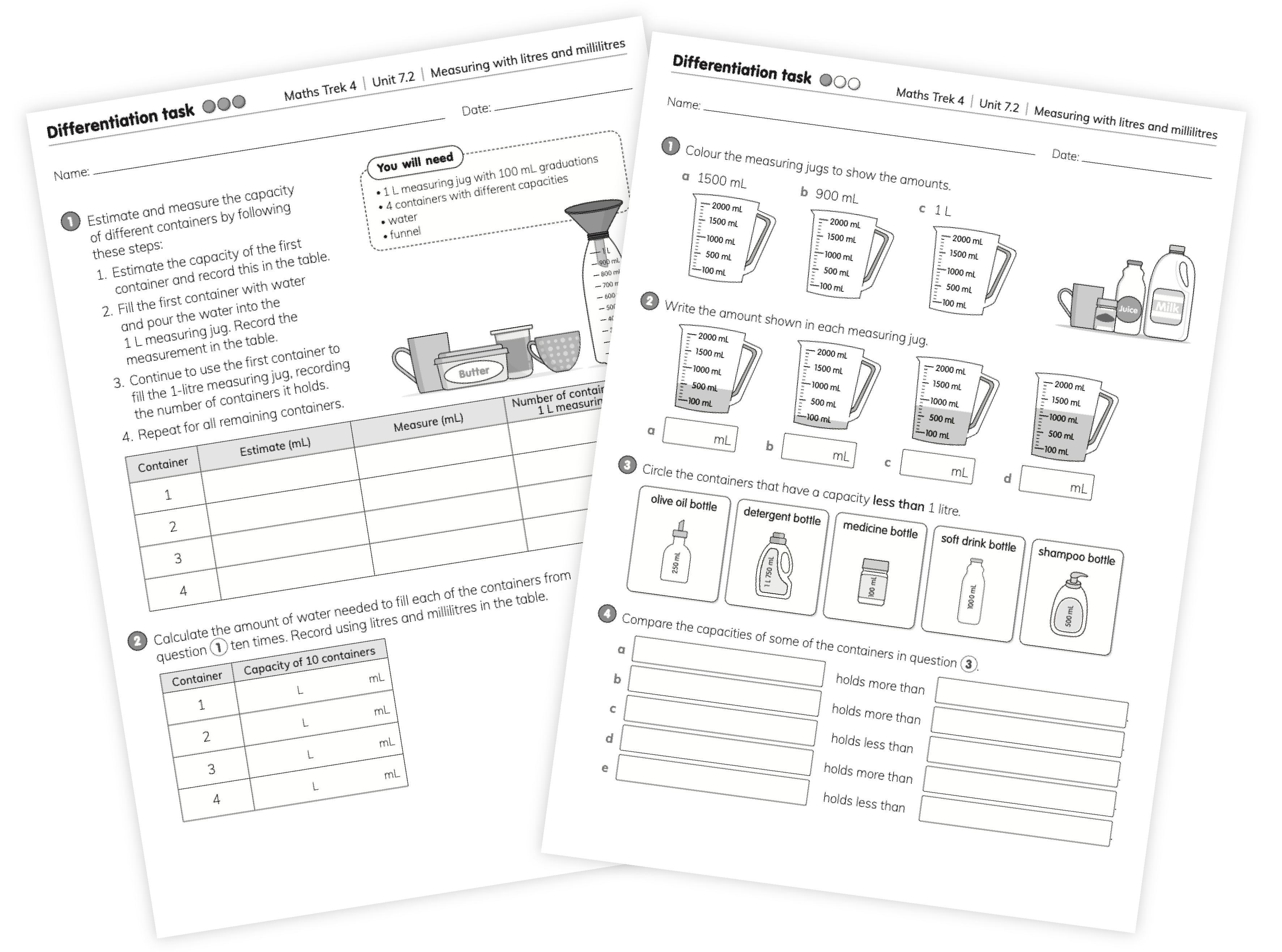
- Every topic lesson includes printable differentiation tasks to support and extend students.
- Investigations in Years 3–6 have inquiry activities, which can be used to extend students or as a class discussion point.
- Challenge tasks are found in many topic units for Years 2–6 to engage fast finishers.
- The Daily Number Practice tool includes eight levels of progression to support fluency of the four operations.
- Problem-solving tasks in the Student Books increase in difficulty so teachers can easily differentiate.
Here’s an example of the differentiation tasks provided in Year 4, Unit 7.2 Measuring with litres and millilitres.
Ready to apply the High Impact Teaching Strategies with your students using Maths Trek? Browse our website to find out more about the program features, sign up for a free trial to explore the resources firsthand or schedule a professional learning workshop for your school.
References
Department of Education and Training, State of Victoria, 2020, High Impact Teaching Strategies: Excellence in Teaching and Learning, https://www.education.vic.gov.au/Documents/school/teachers/support/high-impact-teaching-strategies.pdf↩
Department of Education and Training, State of Victoria, 2022, DET Victoria High Impact Teaching Strategies (HITS), viewed 14 April 2026, https://evidenceforlearning.org.au/education-evidence/aligned-evidence/hits↩
Saligumba, I & Tan, D 2018, ‘Gradual release of responsibility instructional model: Its effects on students’ mathematics performance and self-efficacy’, International Journal of Scientific & Technology Research, vol. 7, no. 8, pp 276–291, https://www.ijstr.org/final-print/aug2018/Gradual-Release-Of-Responsibility-Instructional-Model-Its-Effects-On-Students-Mathematics-Performance-And-Self-efficacy-.pdf↩
Hattie, J 2009, Visible Learning: A synthesis of over 800 meta-analyses relating to achievement, Routledge, Milton Park, UK.↩
Rosenshine, B 2012, ‘Principles of instruction: research-based strategies that all teachers should know’, American Educator, Spring 2012, pp 12–39, https://www.aft.org/sites/default/files/Rosenshine.pdf↩
Attard, C 2017, Promoting creative and critical thinking in mathematics and numeracy, viewed 15 April 2026, https://engagingmaths.com/2017/06/25/promoting-creative-and-critical-thinking-in-mathematics-and-numeracy/↩
The Australian Association of Mathematics Teachers Ltd 2025, Pedagogy in Mathematics Position Paper, viewed 14 April 2026, https://go.aamt.edu.au/2025Pedagogy↩