Articles & Videos
How the explicit teaching of mental computation strategies improves maths fluency
Categories

Subscribe to our newsletters
Receive teaching resources and tips, exclusive special offers, useful product information and more!
How the explicit teaching of mental computation strategies improves maths fluency
Think Mentals 30/7/26
Think about the last time you tried something for the first time, like assembling a bookcase. Imagine how difficult the process would have been if some of the instructions were missing. Sure, you might be able to fumble your way through and finish it, but it might also result in some leftover pieces and crooked shelves.
The same applies when students learn a mental computation strategy without explicit teaching. Some may follow the steps but struggle to apply the strategy in new contexts. For others, the guesswork can be overwhelming and discouraging.
Maths fluency means solving problems quickly, easily and accurately. Explicit teaching and effective modelling are central to building that fluency because they ensure students understand a strategy before they’re asked to apply it independently.
That’s why an effective mental maths program needs to do more than provide practice drills. It needs to teach mental computation strategies in an explicit, systematic, carefully sequenced way, so students build understanding step by step, rather than filling in gaps on their own.
Here are some resources and tips to support your explicit teaching of mental computation strategies to improve maths fluency:
Teach the basic principles behind mental computation strategies
Before students can apply a strategy independently, they need to understand the thinking behind it. Research consistently shows that when strategies are taught using carefully scaffolded, small sequential steps, rather than presented all at once, students are better able to build on prior knowledge and avoid cognitive overload1.
A consistent, whole-school approach to teaching these foundational principles ensures students encounter the same language and sequence across year levels, helping to reinforce learning and make memorisation and recall easier.
In Think Mentals, learning the basics is all about making numbers friendly and forms the first unit in each year level. Students learn how to break tricky maths problems into manageable chunks using a simple two- or three-step sequence. By learning the basics, students learn how to find, make and fix friendly numbers using simple, scaffolded strategies.
Demonstrate how to use each strategy by using clearly explained examples
Clear modelling reduces the cognitive effort required to grasp a new strategy, freeing students to focus on the underlying mathematical thinking rather than decoding the process itself.
Worked examples are step-by-step demonstrations of how to solve a problem. They’re strategies that reduce cognitive load by allowing students to focus on the individual steps required to reach an answer1 2.
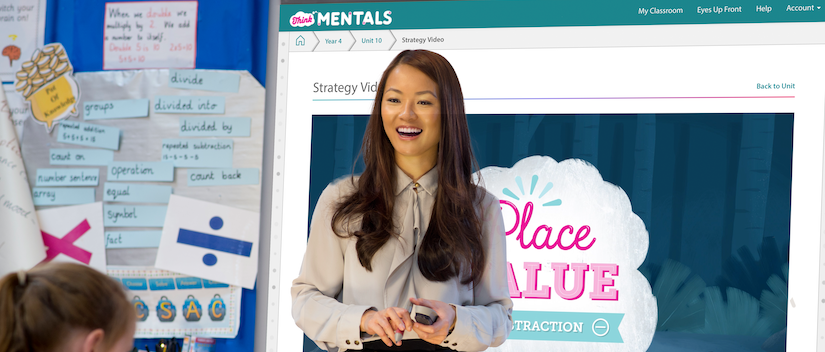
In Think Mentals, if you’re using the Student Workbooks, you can model the strategy for the whole class by projecting the step-by-step examples and strategies from thinkmentalsanswers.com.au onto your smart board. If you’re using the Digital Classroom, these same strategies are available in two handy formats: stepped-out-slideshows and an engaging video for a layered approach to your explicit instruction.
Provide students with plenty of structured practice using the strategy
Independent practice is where understanding becomes fluency, but only when students are ready for it, and when that practice is distributed over time rather than concentrated in a single session.
A meta-analysis by Hattie and Donoghue3 found distributed practice to be among the most effective learning techniques available. Structured, repeated practice also supports automaticity: when basic skills become automatic, working memory is freed up for more complex mathematical thinking1.
To promote fluency in maths, Days 2–4 of the Think Mentals weekly program include:
- dedicated practice of the week’s focus strategy
- revision questions to reinforce previously learned strategies
- a variety of question types that align with the latest Australian Curriculum V9 and NSW Syllabus content strands.
Use the weekly test to provide a snapshot of students’ understanding
Regular, low-stakes assessment gives both teachers and students timely information about where understanding is secure and where gaps remain.
Think Mentals includes a weekly assessment task on Day 5 that contains two sets of questions. The first set assesses students’ understanding and application of all the strategies learned, while the second set tests content across all strands.
If you’re using Think Mentals Student Workbooks, ask students to record their results throughout the year in the Student Assessment Profile at the back of their book. If you’re using Think Mentals Digital, results are automatically collated in the Student Portfolio.
Revise all strategies to consolidate learning
Regular revision is what turns strategy knowledge into genuine fluency.
In Think Mentals, after all the strategies have been introduced for the year, Units 20–32 are specifically designed to revise all strategies. What’s more, students can refer back to strategy examples if they need a reminder of how to apply a certain strategy at any time.
Overall, explicit teaching equips students with strategies they can rely on. Every step matters: the clear modelling, the structured practice, the checks for understanding and the ongoing revision.
When these elements work together, students aren’t just memorising steps. They understand why a strategy works, which means they can apply it confidently to new problems and contexts.
That’s the real goal of maths fluency: not just speed, but genuine understanding that holds up under pressure. Explore the new edition of Think Mentals Student Book pages to see how it all unfolds: Year 1, Year 2, Year 3, Year 4, Year 5, Year 6.
References
- Rosenshine, B 2012, ‘Principles of instruction: Research-based strategies that all teachers should know’, American Educator, Spring 2012, pp. 12-39, https://www.aft.org/sites/default/files/Rosenshine.pdf↩
- Sweller, J 2006, ‘The worked example effect and human cognition’, Learning and Instruction, vol. 16, no. 2, pp. 165-169, https://doi.org/10.1016/j.learninstruc.2006.02.005↩
- Donoghue, GM & Hattie, JAC 2021, ‘A meta-analysis of ten learning techniques’, Frontiers in Education, vol. 6, https://doi.org/10.3389/feduc.2021.581216↩