Articles & Videos
What screen time limits mean for Australian classrooms in 2027
Categories

Subscribe to our newsletters
Receive teaching resources and tips, exclusive special offers, useful product information and more!
Back to Assessment articles & videos
What screen time limits mean for Australian classrooms in 2027
English Stars Maths Trek Sound Waves Writing Time 1/11/26
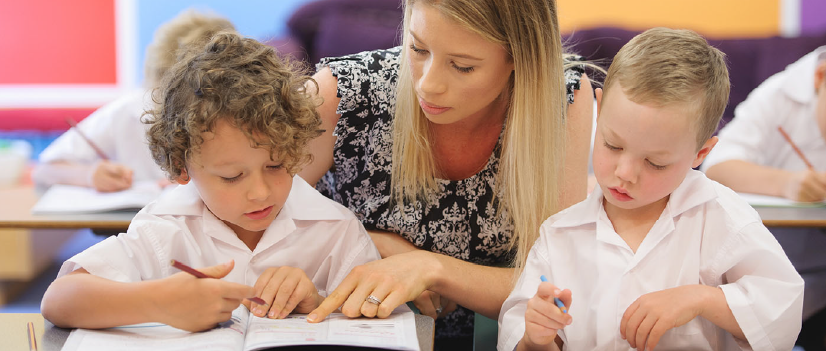
Classroom screen time is about to look very different in Australian schools. From Term 1 2027, NSW is introducing daily limits on student device use, Victoria is capping primary device time and building planned device-free learning into secondary classrooms, and WA is trialling a Back to Basics pilot in the early years.
Why now? The signs have been building for a while. Around a third of Australian students are still falling short in literacy and numeracy,1 2 and recent PISA results were the lowest on record in maths and reading.3
Schools are keen to act. What many need is practical, effective and affordable support to do it well.
If you’re a teacher or school leader wondering what this means for your planning, you’re in good company. Here’s what’s changing in each state, what it means for your lessons and how to get ready without adding to your workload.
What’s happening across Australia?
New South Wales: Daily limits will be 15 minutes for Kindergarten to Year 2, 30 minutes for Years 3 and 4, and 45 minutes for Years 5 and 6, averaged across the school week. Schools are encouraged to start in Term 1 2027, and all schools must implement the guidelines by Term 1 2028.
Victoria: From 2027, Years 3 to 6 are capped at 90 minutes of device use per day, with minimal use in Prep to Year 2. Families will no longer need to provide a device for students in Prep to Year 6. Secondary schools will also include planned device-free time from Term 1 2027.
Western Australia: A ‘Back to Basics’ pilot starts in Term 1 2027 in 10 public primary schools, aiming to restore face-to-face teaching and hands-on learning in the early years (K–2), with $50,000 per school to purchase materials. Alongside the pilot, the WA Government has created a Digital Learning and Screen Use Advisory Group to help shape an evidence-based approach for every year level in its public schools.
Other states: Federal Education Minister Jason Clare has called for a digital detox in schools, and the ACT is reviewing its approach.
Does this mean no technology in the classroom?
No, governments are clear that technology still has a role to play. The time limits are aimed at students on individual devices, not at high-quality essential teaching resources that facilitate explicit teaching.
Explicit teaching works best when it’s scaffolded, systematic and engaging, and digital tools are one of the best ways to ensure consistent and effective teaching takes place across all classrooms. Alongside modelling concepts by hand on a whiteboard, using projectable slides, videos and interactive tools can also help teachers model new concepts clearly and keep every student switched on during this important part of learning.
All states are in agreement. In NSW, the limits cover individual student devices, and interactive whiteboards are described as a tool for teacher-led instruction. WA’s pilot clarifies its restrictions do not apply to smartboards or interactive whiteboards. Victoria’s message is about intent, with devices used where they add something to learning.
The goal is to reduce unnecessary student screen time, not to take effective, purposeful, explicit teaching off the screen at the front of the classroom.
What does the research say?
When students are learning their letters, the research indicates writing by hand seems to give them the edge. In a 2025 study, kindergarten students who learned new letters and words by hand did better than children who typed at naming and writing those letters, reading the words aloud and spelling them.4 The pattern holds across primary school too, with an Australian meta-analysis of 22 studies finding that students produced better quality writing by hand than on a keyboard.5
Then there’s the question of what sticks. Teaching a concept well is one job, and making sure students still remember it next week is another. The practice that follows the lesson is what makes the difference, and handwriting seems to help. Students who wrote stories by hand recalled more details than those who used a laptop or touchscreen,6 and brain imaging suggests writing by hand lights up broader, more connected networks than typing, the kind of activity linked to memory and learning.7 8
What does best practice look like with fewer student screens?
Even with fewer screens, best practice stays the same. Engaging, explicit instruction comes first, followed by hands-on application that lets students put their new knowledge to work.
Picture a maths or literacy block.
I do: You introduce and model the focus, whether that’s a spelling pattern, a grammar concept, a text structure or a maths strategy. Use engaging digital features on the interactive whiteboard, such as slides, videos and games, or print materials. The tools are there to enhance your teaching, not replace it.
We do: The class works through examples together using mini whiteboards, partner talk or hands-on materials, while you check understanding and adjust as you go.
You do: Students practise independently in their Student Books, working with words, applying spelling patterns, writing sentences or progressing through multi-step maths problems.
The first two steps are teacher led, and the screen, if you use one, stays with you. The last step is where every student puts pencil to paper – an essential part of the consolidation process, and where you see who needs more support.
How can schools reduce unnecessary screen time?
Whether you’re preparing for a new limit or simply rethinking everyday practice, a few small steps early on can make the change much smoother.
Take stock: Where are devices used because they’re easy, rather than because they’re the best tool for the job?
Decide what moves to paper: Practice, consolidation and handwriting are natural candidates, since they’re where students benefit most from working by hand.
Protect planning time: Choose ready-to-teach resources with plenty of hands-on activities, so replacing tasks typically completed on a device doesn’t mean increasing teacher workload or building something from scratch.
How does Firefly fit in?
Cutting back on screens shouldn’t mean hours spent creating activities from scratch. Our ready-made programs are built on best practice to help students succeed. Explicit teaching resources help you deliver clear, engaging lessons, and physical Student Books give every student a place to apply and consolidate what they’ve learned. Because the practice is hands-on and directly related to the lesson content, learning sticks without a screen in students’ hands.
We help schools get back to basics with resources you can trust:
Sound Waves: Essential literacy and word study skills are taught explicitly, then consolidated through Student Book activities. Early years students also build their reading skills with sets of Decodable Readers. Hands-on supplementary resources keep lessons engaging – from printable games and worksheets to playing cards and handy phoneme–grapheme charts – providing plenty of ways for students to reinforce their learning. Download our Sound Waves Early Literacy (F–2) Sample Pack or Sound Waves Word Study (3–6) Sample Pack
Maths Trek: Maths concepts are taught explicitly, then consolidated through carefully curated Student Book activities. Hands-on lesson activities help students transition from concrete to abstract thinking. And investigations provide in-depth opportunities for hands-on application of mathematical concepts in real-world contexts, whether they are devising a cafe menu or planning a round-the-world trip. Download our Maths Trek Australian Curriculum Edition Sampler or Maths Trek NSW Syllabus Edition Sampler
Think Mentals: Mental computation strategies are taught explicitly, then practised in targeted Student Book activities that build mathematical fluency. The physical act of jotting helps students hold on to these essential skills, so what they learn sticks. Download our Think Mentals Student Book Sampler.
Writing Time: Writing Time builds the fine motor skills, precision and automaticity that allow students to put their thoughts onto paper quickly and freely. Plenty of explicit, engaging practice helps students form strong handwriting habits, making it a natural fit for screen-free classrooms.
Download our Writing Time Queensland Font Sampler, Writing Time NSW Font Sampler or Writing Time Victorian Font Sampler.
With Term 1 just around the corner, now’s the perfect time to look for new resources that meaningfully replace student screen time and keep the engagement that supports learning. Download sample pages, start your free trials, and chat with your local Education Consultant to ask any questions you have about how our resources can work for your classroom.
References
De Bortoli, L, Underwood, C, Bertling, J 2026, PISA 2025: Reporting Australia’s results. Volume I: Student performance, Report, Australian Council for Educational Research, viewed 18 November 2026, https://doi.org/10.37517/978-1-74286-810-3↩
Hunter, J, Haywood, A, Parkinson, N, Daniel, P 2025, The Maths Guarantee: How to boost students’ learning in primary schools, Report, Grattan Institute, viewed 19 October 2026, https://grattan.edu.au/report/maths-guarantee/↩
Hunter, J, Stobart, A, Haywood, A 2024, The Reading Guarantee: How to give every child the best chance of success, Report, Grattan Institute, viewed 18 November 2026, https://grattan.edu.au/report/the-reading-guarantee/↩
Ibaibarriaga, G., Acha, J. and Perea, M. (2025) ‘The impact of handwriting and typing practice in children’s letter and word learning: implications for literacy development’, Journal of Experimental Child Psychology, 253, article 106195. doi:10.1016/j.jecp.2025.106195.↩
Malpique, A.A. et al. (2024) ‘Effect sizes of writing modality on K–6 students’ writing and reading performance: a meta-analysis’, The Australian Educational Researcher, 51(5), pp. 2001–2030. doi:10.1007/s13384-023-00676-y↩
Frangou, S.-M. et al. (2019) ‘The effect of writing modality on recollection in children and adolescents’, Research in Learning Technology, 27, article 2239. doi:10.25304/rlt.v27.2239↩
Van der Weel, F.R. and Van der Meer, A.L.H. (2024) ‘Handwriting but not typewriting leads to widespread brain connectivity: a high-density EEG study with implications for the classroom’, Frontiers in Psychology, 14, article 1219945. doi:10.3389/fpsyg.2023.1219945↩
Marano, G. et al. (2025) ‘The neuroscience behind writing: handwriting vs. typing, who wins the battle?’, Life, 15(3), article 345. doi:10.3390/life15030345.↩